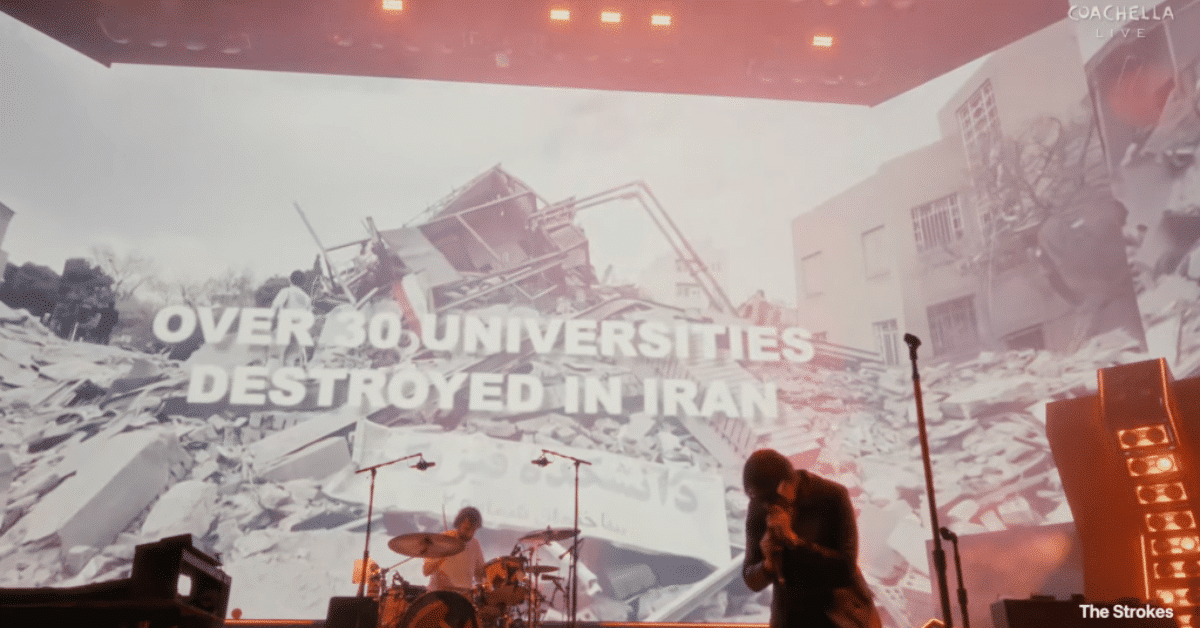

The Strokes brought their Weekend 2 performance at Coachella to a striking and highly political close—one that few in the audience saw coming. As the set reached its finale, the band played a lengthy video montage that sharply criticized the role of the CIA in orchestrating regime changes across different parts of the world over several decades. The sequence built toward a powerful ending, showing footage of Israel bombing Gaza alongside visuals of the United States bombing Iran, leaving viewers with a strong and controversial message.
For audiences both at the festival and those watching via livestream, the moment was completely unexpected. It marked a clear departure from how the band had wrapped up their set during Weekend 1. Adding to the surprise was the choice of song—“Oblivius,” which the band hadn’t performed live since 2016. As the track played, frontman Julian Casablancas repeatedly delivered the line, “What side you standing on?”, giving the performance an even more pointed and confrontational tone.
As the band moved into their final moments on stage Saturday night, they performed against a visually striking illuminated mosque backdrop. Meanwhile, the massive LED screens behind them displayed footage tied to recent U.S. military actions in the Middle East. One segment showed scenes of bombings in Iran, accompanied by the caption, “Over 30 universities destroyed in Iran.” This was followed by a clip depicting a large building in Gaza being demolished in what appeared to be a controlled explosion, paired with the caption: “Last university standing in Gaza.” The imagery was stark and deliberate, designed to leave a lasting impression.
According to Variety, the majority of the montage focused on what the band framed as a long history of American wrongdoing. It moved through different periods, from the era of slavery to more recent military interventions, presenting a narrative that criticized U.S. foreign and domestic actions. The decision to include the Israeli-Palestinian conflict toward the end of the montage stood out in particular, especially in light of the controversy at last year’s Coachella. In 2025, the group Kneecap sparked backlash after using their performance to condemn Israel’s military actions in the Middle East—though in a far more explicit and provocative manner.
Reactions from fans quickly began pouring in online. One attendee who shared a video of the performance’s climax on X wrote, “This was the moment the Strokes ensured they’ll never set foot in Coachella again! I’m so proud of them.” Despite such claims, it seems unlikely that the band will face any kind of ban or exclusion. In fact, they are already scheduled to headline another major festival organized by Goldenvoice later this year in Southern California.
Unlike the Kneecap incident the previous year—which reportedly caught festival organizers off guard—this time the response from Coachella appeared measured and prepared. The official YouTube livestream included wide-angle shots that clearly captured the controversial visuals, suggesting that the organizers were aware of and willing to present the band’s message as part of the performance.
A large portion of the video montage focused on longstanding allegations about CIA involvement in global political events. The visuals claimed that the agency had a hand in overthrowing governments in South America and even suggested involvement in assassinations of political leaders. It also referenced conspiracy theories surrounding the death of civil rights icon Martin Luther King Jr.. One caption displayed after showing his image read: “US govt found guilty of his murder in civil trial.” This refers to a 1999 civil case, though it’s worth noting that the U.S. Justice Department later stated in 2000 that there was no evidence supporting the jury’s conclusion.
The montage continued by pointing to several other historical events where U.S. intervention has been alleged. Among them were claims that the CIA may have been involved in the 1981 plane crashes that killed Panamanian president Omar Torrijos and Ecuadorian president Jaime Roldós (misspelled as “Equador” in the video). It also referenced the 1953 overthrow of Iranian Prime Minister Mohammad Mossadegh, the 1973 coup against Chilean president Salvador Allende, and the removal of Bolivian president Juan Torres in 1976.
The montage reached its climax with the previously mentioned footage of bombings in Iran and Gaza. As the visuals played out, the performance came to an abrupt end, closing on an image of a bomber plane in flight while the music cut off suddenly—leaving the audience in a moment of silence and reflection.
Initial reactions from many fans appeared largely positive, especially among those who follow the band closely. Comments on their social media praised them for using their platform to draw attention to global issues. Messages like “Thank you so much for using your stage to highlight Gaza and Iran and Latin America” and “Amazing show and a bombshell of reality at the end!” reflected a sense of admiration from a significant portion of their fanbase.
At the same time, as clips from the performance continue to circulate online, stronger reactions—particularly from pro-Israel listeners and more conservative audiences in the United States—are expected to emerge. Still, for many longtime followers of the band, the move aligns with Julian Casablancas’s known views. The singer has previously voiced support for Palestine and was among the artists who signed the “Musicians for Palestine” letter in 2021.
Following their Coachella appearances, The Strokes have announced plans for a world tour set to begin in June and continue through the fall. The tour will include a major headlining performance at the Just Like Heaven festival in Pasadena this August, further cementing the band’s continued presence on the global music stage—even as their latest performance sparks conversation far beyond music itself.