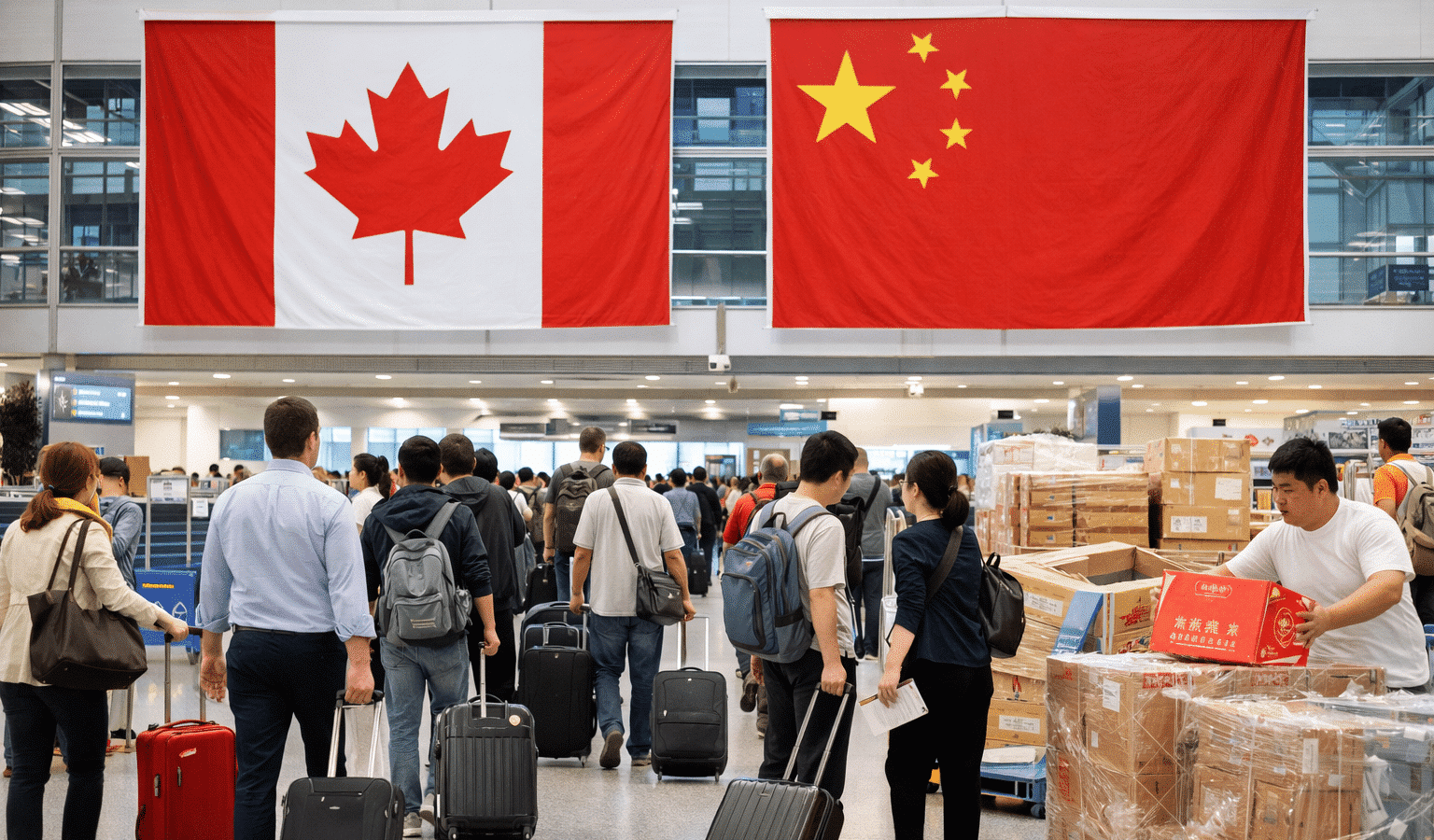

The federal government has announced an incremental increase in the number of direct flights permitted between Canada and China, marking a notable step in Ottawa’s efforts to deepen economic and travel links with Beijing. The move gives Canadian and Chinese airlines more flexibility to raise passenger and cargo operations, reflecting a broader push to diversify trade and improve connectivity with one of Canada’s key global partners.
Transport Minister Steven MacKinnon unveiled the changes, saying they build on Prime Minister Mark Carney’s recent visit to Beijing and deliver on the Canada‑China Economic and Trade Cooperation Roadmap. The updated arrangement allows both sides to gradually expand direct passenger‑combination flights, add up to 20 all‑cargo flights per week and grant reciprocal access to virtually all points within each country. In practice, that means carriers can serve more cities and routes between Canadian provinces and Chinese regions, giving businesses and travellers more options.
Officials say the extra capacity will support trade diversification, help strengthen supply chains and give Canadian exporters more reliable routes to reach Chinese markets. China is currently Canada’s second‑largest single‑country merchandise trading partner, with more than 124 billion dollars in two‑way trade in the most recent full year. Exports from Canada to China reached about 34 billion dollars, while imports from China were valued at roughly 90 billion dollars, underscoring the scale of the commercial relationship involved.
The government is also framing the move as a way to reinforce people‑to‑people ties. More direct flights can ease travel for students, families, tourists, business delegations and cultural groups, while reducing the need for time‑consuming connections through third‑country hubs. Federal officials say the change will give Canadian travellers more choice, more convenient schedules and better access to major Chinese cities, which in turn can support tourism and academic exchanges.
The new flight allowances take effect immediately, with airlines expected to adjust timetables and route planning over the coming months. Canadian carriers may introduce additional frequencies on existing routes or evaluate new city‑pair connections, while Chinese airlines can expand their presence in multiple Canadian gateways. The cap on 20 all‑cargo flights per week is designed to balance growth with capacity constraints at major airports and cargo hubs.
Ottawa is also using the adjustment as part of a wider strategy to modernize Canada’s air transport network abroad. The government notes it already has air agreements or arrangements with more than 125 countries and is continuously working to expand and update these deals to keep up with shifting trade and travel patterns. By improving connectivity with China, officials say Canada is positioning itself to increase exports, attract more visitors and support long‑term economic growth.
International Trade Minister Maninder Sidhu said the move strengthens the trade corridors that Canadian exporters depend on every day. He said smoother air links will help businesses move goods more efficiently, reduce delivery times and support Ottawa’s goal of significantly increasing exports to China over the medium term. For sectors such as agri‑food, technology, natural resources and advanced manufacturing, faster and more frequent air cargo options can make a measurable difference in competitiveness.
At the same time, the government is aware of the sensitivities surrounding Canada‑China relations. The new flight framework is framed in economic and transport terms, but it nonetheless signals a recalibration of bilateral ties amid ongoing geopolitical and commercial challenges. By focusing on trade, logistics and travel, Ottawa is trying to keep Canada’s commercial relationship functional while navigating broader foreign‑policy tensions.
For Canadian travellers, the practical impact is likely to be felt in coming months. Those heading to China for business, study or family visits may see more non‑stop options, better departure times and more competitive pricing as airlines compete for traffic.
Cargo‑dependent industries, including e‑commerce and high‑value perishable goods, stand to benefit from more weekly cargo flights and improved network coverage.
Overall, the expanded flight access is being presented as a relatively low‑profile but strategically important adjustment. It does not single‑handedly reshape Canada‑China relations, but it does send a signal that trade and connectivity remain priorities for Ottawa, even as the broader relationship evolves. As airlines begin to implement the new allowances, the effects will ripple through Canada’s airports, business community and diaspora, reshaping the way Canadians connect with one of the world’s largest economies.

Harnaik Singh Rathor is the Founder, Publisher, and Editor-in-Chief of StudioX News Canada, Canada's multilingual digital news network serving diaspora communities across 44 languages. With a background in media production, public relations, and multicultural communications, he founded StudioX Film and TV Corporation to bridge the gap between mainstream Canadian media and the country's diverse immigrant communities. He is a member of the Canadian Association of Journalists (CAJ), RTDNA Canada, CPRS Vancouver, NEPMCC, and the Canadian Freelance Union (Unifor). Based in Surrey, British Columbia. | LinkedIn: https://www.linkedin.com/in/harnaiksinghrathor/ | Muck Rack: https://muckrack.com/harnaiksinghrathor | Email: editor@studioxnews.ca