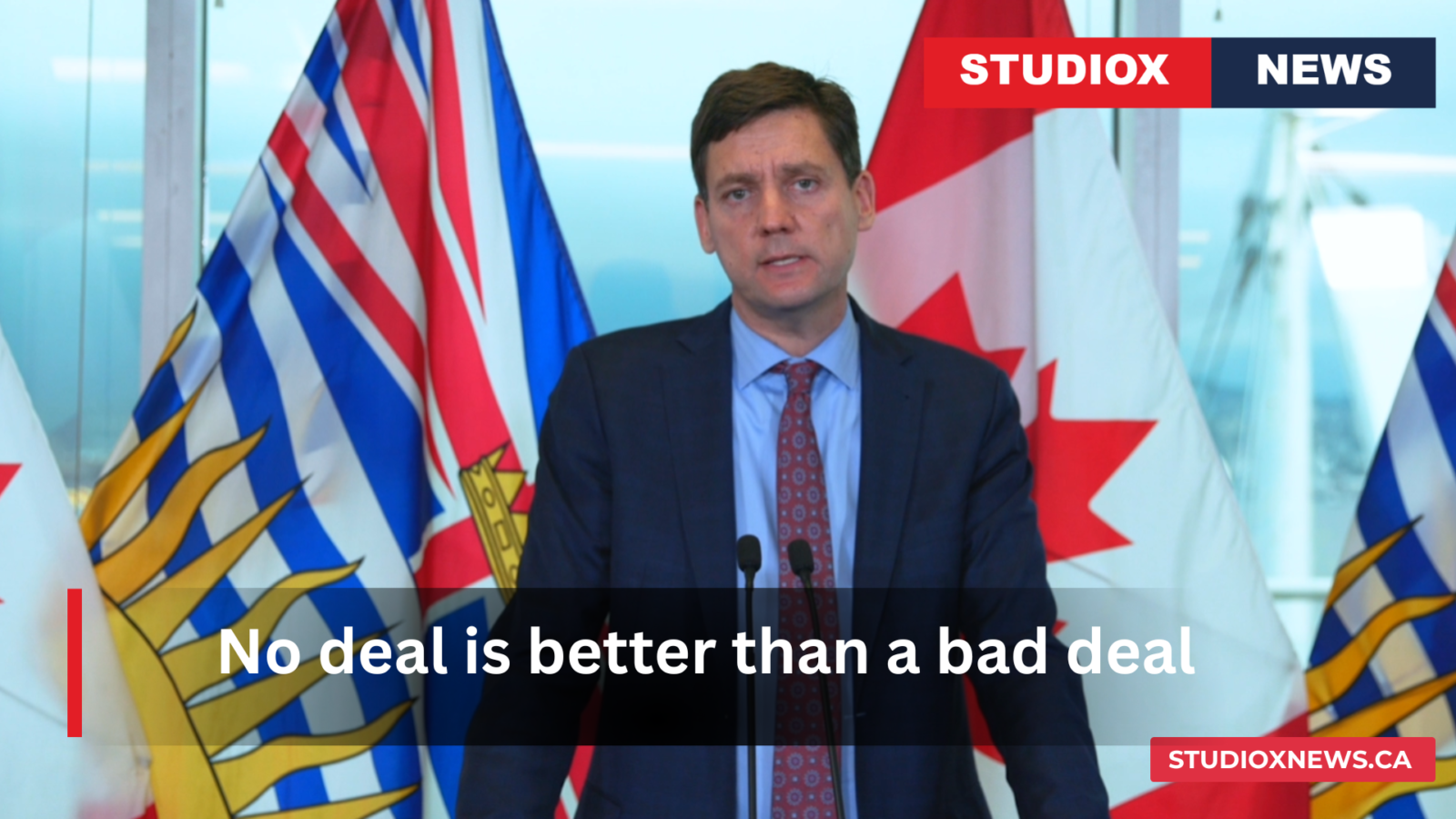
British Columbia Premier David Eby on Saturday firmly backed the federal government’s decision to walk away from Canada-US trade talks, describing the new 50 per cent tariffs as an “inexplicable and indefensible” economic attack on the province and the country.
Speaking at a news conference in Vancouver, Eby said the latest developments revealed the true nature of what the current US administration is seeking from Canada. He praised Prime Minister Mark Carney and federal negotiators for refusing terms that would have required Canada to limit trade with other countries.
“The suggestion that Canada would not trade with other countries or reduce our trade with other countries because the Americans tell us to would reduce us to the economic equivalent of the 51st state,” Eby said. “It’s never acceptable to Canadians and the prime minister and his team rightly walked away from any suggestion that we would agree to that.”
The new tariffs took effect after midnight Friday following the collapse of last-minute talks. They hit a range of Canadian goods, including plywood, veneer, aluminum products, electronics, seeds, shrubs and bulbs — sectors that employ many workers in British Columbia.
Eby said he had warned two years ago that Trump tariffs represented an economic attack on the province. He argued that long-term security requires Canada to diversify markets rather than remain dependent on an unreliable partner.
“It is clear that the current US administration cannot be trusted,” Eby said. “You just can’t trust Trump. Even if an agreement had been signed, how long would it have lasted? For long-term economic security for British Columbians and Canadians we have to strike out on our own, we have to stand on our own two feet.”
Softwood Lumber and the US Liquor Ban
Eby was unequivocal on British Columbia’s retaliatory measures. American liquor will remain off provincial liquor store shelves until forest families are treated fairly.
“My message to the Prime Minister and to the American Ambassador and to American politicians who have asked has always been the same,” he said. “That once forest families who work in the forest sector in British Columbia are treated fairly that we would be happy to put American booze back on the shelves. Obviously that is not the case.”
He noted that Canadian softwood products currently face higher tariff rates than those from Russia and the European Union, calling the situation “profoundly unfair” and damaging to both Canadian jobs and American consumers facing higher costs for home renovations and construction.
“Every possible tool, every weapon that can be deployed by the federal government in this economic war that is being waged on Canada is on the table for British Columbia,” Eby said. He stressed that standing up to a bully is necessary, because failing to do so only invites further pressure.
Support for Small and Medium Businesses
Eby highlighted the particular vulnerability of smaller manufacturers, many with 20 to 50 employees, that lack the resources to navigate complex federal support programs. He said one of the key points raised with the Prime Minister and Minister Dominic LeBlanc was the need for more accessible aid with less bureaucracy.
British Columbia is among the most exposed provinces to the latest round of tariffs. Cities such as Abbotsford, where more than 90 per cent of local exporters ship primarily to the United States, face significant pressure. Eby said the province will work closely with Ottawa to ensure affected businesses receive timely support and that any disproportionate burden on BC is matched by federal assistance.
“There is no question that there will be economic pain associated with this,” he said. “There already is. But it is necessary to stand up to a bully.”
Diversifying Trade and Standing on Our Own Feet
Eby emphasized that British Columbia and Canada have already been expanding markets through trade missions, new trade offices and outreach to countries that want Canadian products. He pointed to the potential of a free-trade agreement with India, which currently applies a 10 per cent tariff on Canadian wood products, as one example of the opportunities ahead.
“We have to do the uncomfortable but necessary work of reaching out and increasing our trade diversification around the world to ensure that we will not be held hostage,” he said. “Canada has what the world wants.”
He rejected any notion that the Canada-US relationship can simply return to its previous form. The relationship has fundamentally changed, he argued, and the response must be to strengthen Canada’s economic independence while supporting workers through the transition.
Critical Minerals and Long-Term Independence
Responding to questions about using critical minerals as leverage, Eby called the US approach contradictory. American officials continue to seek secure Canadian supply chains for rare earths and other minerals while the administration simultaneously attacks key Canadian sectors.
“The idea that you can simultaneously attack Canadians and also benefit from what’s in Canada… is an absurd one,” he said. “It is the definition of an abusive relationship.”
Every tool remains on the table, he added, including measures that could highlight the mutual benefits of the trade relationship. The priority, however, is building resilience so future generations are not placed in the same vulnerable position.
Eby closed by expressing pride in how British Columbians and Canadians have responded and commitment to supporting hard-working families affected by the tariffs. “We will work hard to ensure that those British Columbians are supported and work with the federal government to ensure all Canadians benefit from living in this incredible country as we build the strong Canada that our kids deserve.”
Quick Facts
- New 50% US tariffs took effect after trade talks collapsed late Friday, Aug. 21 / early Saturday, Aug. 22, 2026.
- Prime Minister Mark Carney said Canada walked away after last-minute US demands were deemed unfair.
- Canada will match US tariffs dollar-for-dollar starting Sept. 8.
- BC softwood lumber and value-added wood products remain under heavy tariff pressure; US alcohol stays off BC shelves.
- Premier Eby: “No deal is better than a bad deal.”
- Focus on accessible support for small and medium-sized businesses and accelerated trade diversification.

Harnaik Singh Rathor is the Founder, Publisher, and Editor-in-Chief of StudioX News Canada, Canada's multilingual digital news network serving diaspora communities across 44 languages. With a background in media production, public relations, and multicultural communications, he founded StudioX Film and TV Corporation to bridge the gap between mainstream Canadian media and the country's diverse immigrant communities. He is a member of the Canadian Association of Journalists (CAJ), RTDNA Canada, CPRS Vancouver, Unifor, NEPMCC, and the Canada Freelance Union. Based in Surrey, British Columbia. | LinkedIn: https://www.linkedin.com/in/harnaiksinghrathor/ | Muck Rack: https://muckrack.com/harnaiksinghrathor | Email: editor@studioxnews.ca