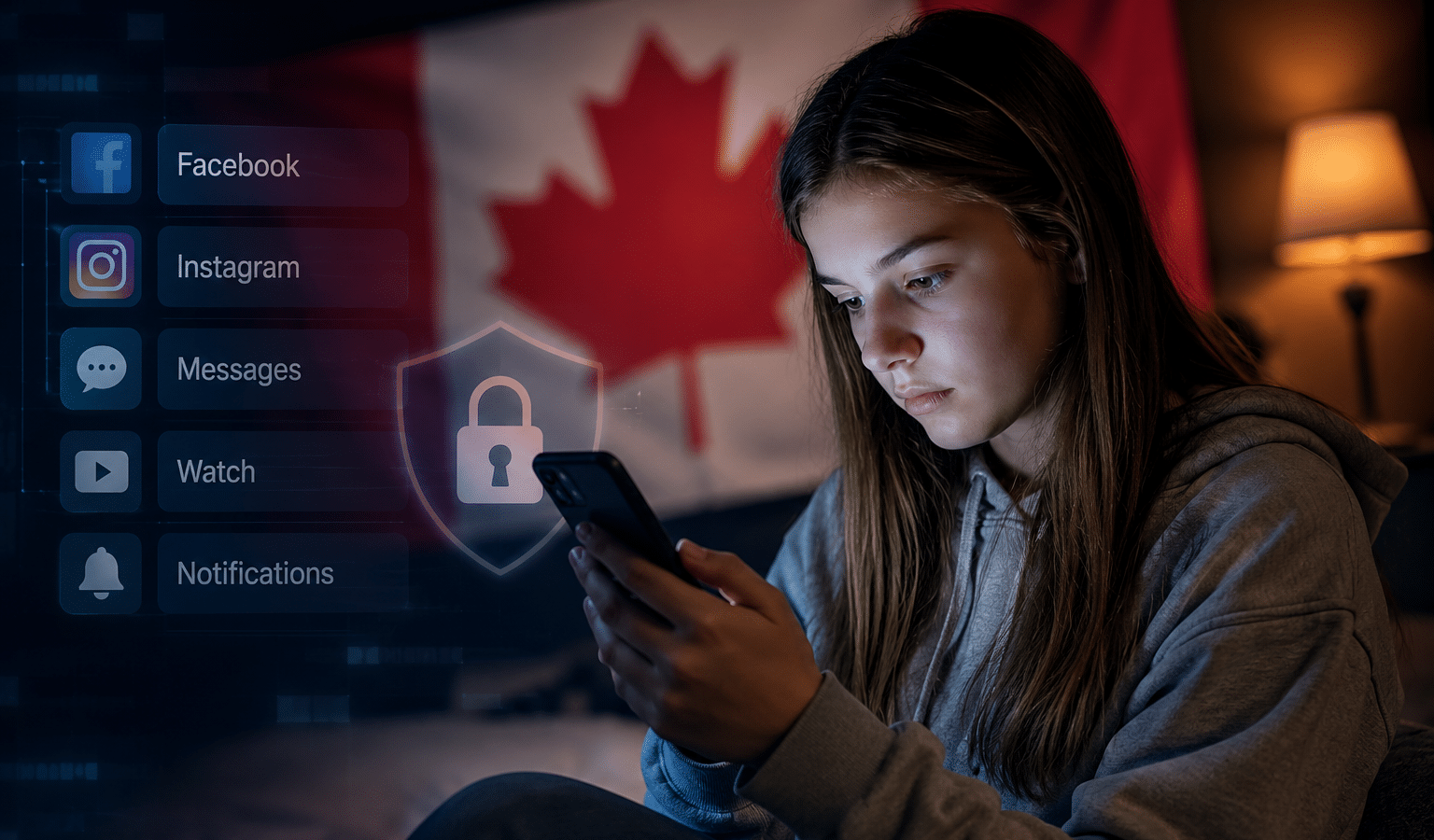
VICTORIA — Meta youth safety protections in Canada are at the centre of a new call from B.C. Attorney General Niki Sharma, who is urging the technology giant to extend safeguards being introduced for young people in the United States to Canadian children and teenagers.
Sharma said Canadian families should not have to wait for the outcome of lawsuits before receiving stronger protections on major social media platforms.
“Canadian children deserve the same online protections as American children,” Sharma said in a statement issued Sunday.
Her comments follow Meta’s agreement with a bipartisan group of U.S. attorneys general and a settlement valued at up to US$18 billion over allegations involving the impact of social media platforms on children and teenagers. Meta has announced a series of new measures for users under 18 on Facebook and Instagram in participating U.S. states and territories.
Meta youth safety protections Canada: What is B.C. asking for?
Sharma is calling on Meta to immediately implement similar protections for young users in Canada.
The B.C. attorney general said the safeguards being introduced in the United States demonstrate that stronger protections for children and teenagers are both possible and necessary.
Meta has outlined several measures as part of its agreement with U.S. state attorneys general, including:
- A default two-hour daily time limit across Facebook and Instagram, which teens can only turn off with parental permission.
- A default overnight block restricting access to certain app features between midnight and 6 a.m.
- A school mode that mutes most notifications between 8 a.m. and 3 p.m.
- Regular prompts after periods of continuous screen time.
- New parental supervision controls.
- Additional measures aimed at strengthening age-related protections for younger users.
Meta said it wants the new approach to become an industry-wide standard and has publicly called on TikTok and YouTube to adopt similar measures for teenagers.
However, Sharma says Canadian children should not be excluded from protections being made available to young users in the United States.
Canadian families should not have to wait
The B.C. government says there are ongoing lawsuits in Canada involving social media platforms, but Sharma argues that families should not have to wait for lengthy court proceedings before companies introduce safeguards.
“There are many open lawsuits in Canada against social media platforms, but Canadian families should not have to wait for the outcomes of lawsuits to benefit from safeguards,” Sharma said.
She urged Meta to address the widest possible range of issues affecting the safety and well-being of young people online.
“It should not take legal action for a company to do what is right to protect young people on its platforms,” Sharma said.
The debate over social media safety has increasingly focused on how platforms are designed and how features such as notifications, recommendation systems and continuous scrolling may influence the amount of time young people spend online.
The new U.S. measures place particular attention on screen time, late-night access and parental oversight — areas that have become central to broader discussions about how technology companies should protect younger users.
What could stronger safeguards mean for Canadian families?
For Canadian families, similar protections could mean additional default safeguards rather than relying entirely on parents and teenagers to find and activate individual settings.
Measures such as stronger age-related checks, limits on prolonged use, reduced notifications during school hours and restrictions on late-night access could provide additional layers of protection for younger users.
Sharma’s position is that if these measures can be introduced in the United States, there is no reason Canadian children should have to wait for separate legal action before receiving comparable protections.
The issue also raises broader questions about whether global technology companies should apply different standards for children depending on where they live.
Meta itself has argued that youth safety requires broader industry participation, saying teenagers often move between multiple apps and that restrictions on one platform can lead users to shift to another. In its open letter, the company called on TikTok and YouTube to join the effort to establish similar protections.
B.C.’s record on online safety
Sharma said British Columbia has taken a leading role in strengthening protections against online harms.
She pointed to the province’s Intimate Images Protection Act, which provides legal tools for people dealing with the non-consensual sharing of intimate images and is part of B.C.’s broader approach to online safety.
The provincial government has also advocated for stronger federal action on online harms and social media safety.
Sharma said B.C. has “never been afraid to stand up to powerful corporations and hold them accountable when their products or practices cause harm to people and communities.”
The province’s online safety framework reflects growing concerns about the rapid evolution of digital platforms and the challenges families face as children and teenagers spend more time online.
More information about B.C.’s Intimate Images Protection Act and consent protections is available through the provincial government.
Pressure grows for stronger protections
The U.S. settlement has added new momentum to the international debate over children’s safety on social media.
While Meta has denied wrongdoing, the company has agreed to significant changes affecting teenage users as part of its agreement with U.S. attorneys general. The agreement includes financial commitments and platform safeguards that could remain in place for years.
For Sharma, the immediate question is whether those protections will be extended beyond the United States.
Her message to Meta is clear: Canadian children deserve the same level of online protection as their American counterparts.
B.C. says it will continue pushing for stronger and enforceable safeguards to protect children and young people online while holding companies accountable when their products or practices cause harm.
As governments, parents and technology companies continue to debate the future of youth safety online, Sharma says Canadian families should not have to wait for court decisions before meaningful protections are put in place.

Harnaik Singh Rathor is the Founder, Publisher, and Editor-in-Chief of StudioX News Canada, Canada's multilingual digital news network serving diaspora communities across 44 languages. With a background in media production, public relations, and multicultural communications, he founded StudioX Film and TV Corporation to bridge the gap between mainstream Canadian media and the country's diverse immigrant communities. He is a member of the Canadian Association of Journalists (CAJ), RTDNA Canada, CPRS Vancouver, Unifor, NEPMCC, and the Canada Freelance Union. Based in Surrey, British Columbia. | LinkedIn: https://www.linkedin.com/in/harnaiksinghrathor/ | Muck Rack: https://muckrack.com/harnaiksinghrathor | Email: editor@studioxnews.ca