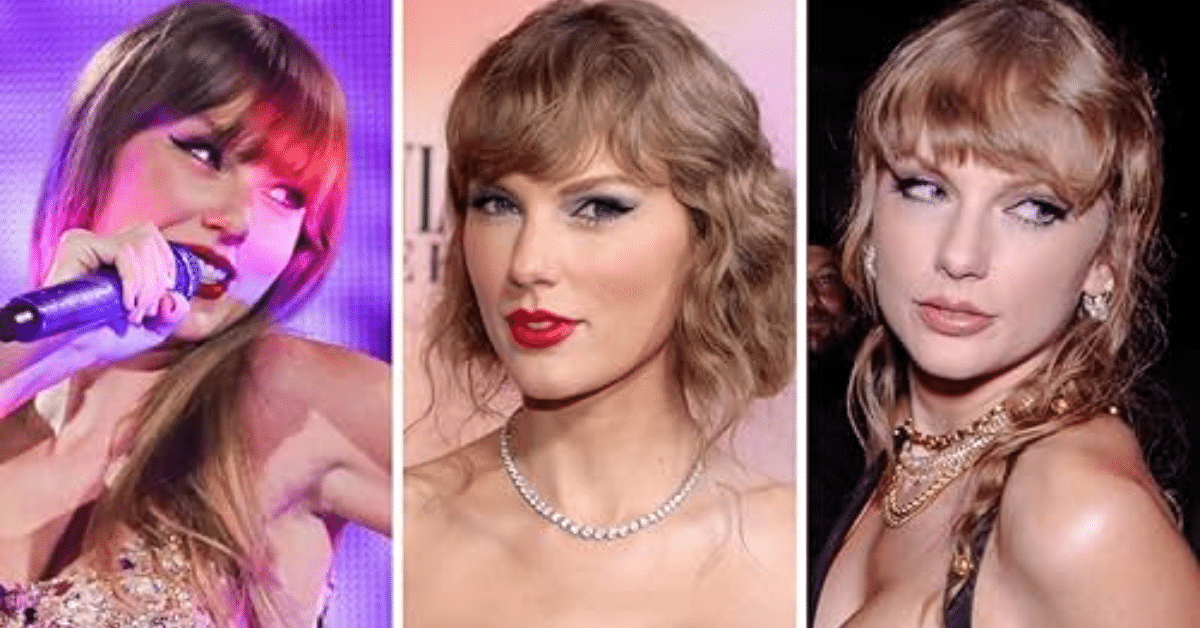

In an era where AI is blurring the lines between what’s real and what’s not, Taylor Swift is taking a proactive step to protect something deeply personal — her voice and image. On Friday, April 24, Swift’s company filed three trademark applications with the U.S. Patent & Trademark Office. Two focus on sound trademarks tied to her voice — “Hey, it’s Taylor Swift,” and “Hey, it’s Taylor.” The third is a visual trademark describing “a photograph of Taylor Swift holding a pink guitar, with a black strap and wearing a multi-colored iridescent bodysuit with silver boots.
She is standing on a pink stage in front of a multi-colored microphone with purple lights in the background.” The filings were made through her company, TAS Rights Management, and first spotted by intellectual-property attorney Josh Gerben. According to Gerben, moves like this reflect a growing concern in the entertainment world about AI tools potentially copying an artist’s voice or likeness without permission.
Why AI Is Raising Alarm Bells
Traditionally, trademarks haven’t been used to protect a person’s general likeness or voice. But that’s starting to shift. The idea is to create an additional legal layer — something that could help artists fight back against AI-generated content that mimics them. Swift has already faced this issue firsthand. Her likeness has appeared in AI-generated content without her consent, including outputs linked to Meta’s AI chatbots and explicit fake images circulating online. During the lead-up to the 2024 U.S. presidential election, Donald Trump even shared AI-generated images falsely suggesting she had endorsed him.
Following a Growing Trend
Swift isn’t alone in this approach. Actor Matthew McConaughey has already explored similar legal ground. In 2025, the U.S. Patent & Trademark Office granted him eight trademarks, including a sound mark for his iconic line, “Alright, alright, alright!” from the film Dazed and Confused, along with audio and video clips of him.
The idea behind this “trademark yourself” strategy is simple: it gives celebrities another legal tool to challenge unauthorized AI replicas of their identity. While states like New York and California already have right-of-publicity laws, trademark cases can be taken to federal court — making them a potentially stronger deterrent.
A Legal Strategy Still Being Tested
In a blog post, Gerben explained how Swift’s filings could work in practice. “Theoretically, if a lawsuit were to be filed over an AI using Swift’s voice, she could claim that any use of her voice that sounds like the registered trademark violates her trademark rights,” he wrote. He added that the image-based filing “serves a similar purpose,” potentially helping her challenge AI-generated visuals that resemble her signature style.
Even so, this strategy hasn’t yet been fully tested in court when it comes to AI. But it could open the door to actions like takedown requests — similar to how studios enforce copyrights. For example, in December 2025, The Walt Disney Company sent a cease-and-desist letter to Google over its Gemini AI platform, alleging it was being used to generate unauthorized versions of its characters. The content was reportedly removed within a day.
“Ultimately, Taylor Swift and Matthew McConaughey’s recent trademark filings are testing new theories on how trademark law will work in the AI age,” Gerben wrote.
Another Legal Battle Brewing
At the same time, Swift is dealing with a separate trademark dispute. In March, Las Vegas performer Maren Wade filed a lawsuit claiming that Swift’s 2025 album The Life of a Showgirl infringed on her earlier trademark, “Confessions of a Showgirl.” The U.S. Patent & Trademark Office had already rejected Swift’s attempt to trademark “Life of a Showgirl” for live entertainment services, citing potential confusion with Wade’s existing claim.
As AI continues to evolve, so do the legal strategies around it — and Swift’s latest move shows just how seriously artists are taking the fight to protect their identity in a rapidly changing digital world.

Harnaik Singh Rathor is the Founder, Publisher, and Editor-in-Chief of StudioX News Canada, Canada's multilingual digital news network serving diaspora communities across 44 languages. With a background in media production, public relations, and multicultural communications, he founded StudioX Film and TV Corporation to bridge the gap between mainstream Canadian media and the country's diverse immigrant communities. He is a member of the Canadian Association of Journalists (CAJ), RTDNA Canada, CPRS Vancouver, NEPMCC, and the Canadian Freelance Union (Unifor). Based in Surrey, British Columbia. | LinkedIn: https://www.linkedin.com/in/harnaiksinghrathor/ | Muck Rack: https://muckrack.com/harnaiksinghrathor | Email: editor@studioxnews.ca