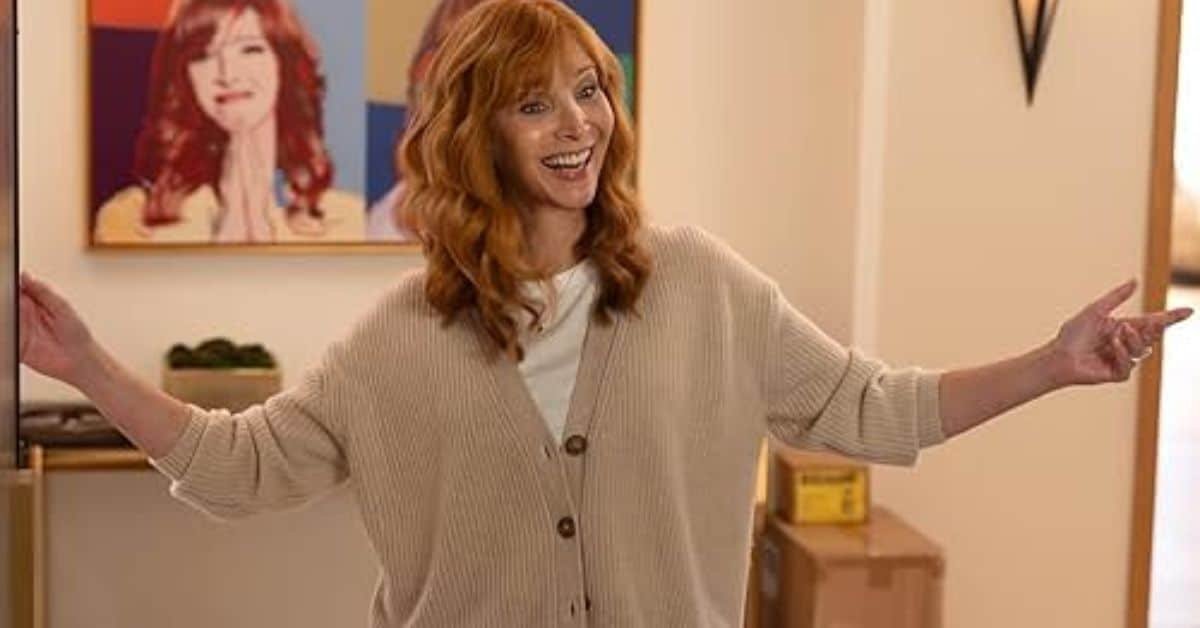

Five minutes before the credits roll, “The Comeback” appears headed for a bleak ending. Valerie Cherish, the sitcom actress and early reality TV star played with relentless optimism by comedy veteran Lisa Kudrow, finds herself trapped. She has finally become the star of a hit show, the classic multi-camera sitcom “How’s That?!” on streaming platform NuNet. But there’s a catch — she has also become the face of television written by artificial intelligence, something more than 70% of viewers apparently have no issue with.
By agreeing to this Faustian deal, Valerie has effectively sabotaged herself. When she finally realizes she can’t continue working with AI-generated scripts — a turning point that comes only after NuNet executive Brandon, played by Andrew Scott, dismisses sitcoms as “easy-peasy” shows that “don’t need genius” — Valerie decides to quit. But she soon discovers she herself can also be replaced by AI after unknowingly signing away the rights to her likeness through DocuSign.
Later, Valerie discusses the situation with her husband Mark, played by Damian Young. She must decide whether to stand by her principles and allow a machine to take over her role — “cut off my nose to fight my face,” as she says in classic Valerie fashion — or continue working in an environment where she feels belittled and undervalued. “I think we both know what you’re going to do,” Mark says with resignation. He expects her to endure the humiliation and return to the set, just as she has done countless times before.
Unexpectedly, Valerie is offered a way out. Influential showrunner Jack Stevens, portrayed by Bradley Whitford, reaches out with a new opportunity. Earlier, Jack had urged Valerie to publicly support the writers during the show’s renewal press conference. Although Valerie did briefly embarrass the studio by recounting a story about the AI system shutting down after hitting a paywall, her comments came more from frustration than principle. Still, Jack now wants her for a new project. He writes a role specifically for her — a woman with gravitas, humor and strong morals. Valerie is suddenly offered the rare chance to keep both her fame and her integrity, even if the rest of Hollywood may not be so fortunate. The end credits reveal that she later wins a second Emmy for “Judge’s Table,” where she plays judge-turned-chef Eleanor Judge.
The finale felt like an appropriate conclusion to the last season of The Comeback, where Kudrow and co-creator Michael Patrick King seemed caught between two competing goals. On one side, they wanted to critique the growing influence of AI in creative industries, offering a dark satire much like the show’s earlier takes on reality television and prestige dramas. On the other, they clearly wanted to celebrate Valerie Cherish herself, a character they have nurtured for over two decades. When documentarian Jane, played by Laura Silverman, tells Valerie, “I’ve watched you for 20 years,” it feels like a direct reflection of how long-time viewers feel about her journey.
Ultimately, those two ambitions never fully came together. Kudrow and King chose affection over harsh critique, protecting Valerie from the full consequences of the AI-driven industry they had spent the season examining. The show also took certain creative liberties, especially considering real-world protections against AI writing and image replication already exist in WGA and SAG agreements formed after the strikes referenced earlier in the season.
This softer approach was visible even before the finale. In the second-last episode, Valerie reunites with her former co-star Juna, played by Malin Akerman, on the studio lot. Juna, now a major star, tells Valerie with admiration that “to me, you’re it.” The line may not entirely fit the reality of Juna’s greater success or Valerie’s controversy as the public face of AI-written television, but emotionally, it still lands. After everything Valerie has endured — including once vomiting on camera while dressed in a cupcake costume — part of the audience wants to see her finally get a happy ending.
The series itself seems conflicted about whether she truly deserves one. Valerie Cherish is inseparable from “The Comeback,” but the needs of the character and the needs of the story may no longer align perfectly. Over the years, Valerie has evolved significantly. In Season 2, she skipped the Emmys to be with her ill hairstylist Mickey, played by Robert Michael Morris. By Season 3, she had become an executive producer, standing up for writers and fellow cast members from a genuine position of influence. Yet she also willingly accepted an AI-written role in the first place and continues to exist within a struggling entertainment industry that repeatedly forces her into impossible compromises. Both Valerie and Hollywood may have changed, but not necessarily in the same direction.
Even so, the emotional power of the final scene is difficult to resist. Valerie sits down for one last interview with Jane as the picture slowly transforms from grainy black-and-white into crisp color. Reflecting on the humiliation that outsiders so often associate with her, Valerie firmly says, “I never felt that — humiliation. I think you have to agree to be humiliated, and I never signed up.” The moment becomes a reclaiming of agency, suggesting that Valerie has always had ownership over her choices, no matter how messy or painful they seemed. It also carries far more emotional complexity than Jane’s earlier comment: “Finally, it all worked out — what an evolution you’ve had!”
In its final episodes, “The Comeback” constantly balanced between forced optimism and genuinely nuanced storytelling. The closing joke — a callback to Valerie once declaring “Well, I got it!” while Jane directed her — worked on both levels at once. It served as obvious fan service while also acknowledging how far Valerie had come, blending sincerity with the show’s trademark self-awareness. Whether she truly earned it or not, Valerie Cherish ultimately gets everything she ever wanted. And whether entirely successful or not, “The Comeback” gave its all trying to make that ending feel deserved.

Harnaik Singh Rathor is the Founder, Publisher, and Editor-in-Chief of StudioX News Canada, Canada's multilingual digital news network serving diaspora communities across 44 languages. With a background in media production, public relations, and multicultural communications, he founded StudioX Film and TV Corporation to bridge the gap between mainstream Canadian media and the country's diverse immigrant communities. He is a member of the Canadian Association of Journalists (CAJ), RTDNA Canada, CPRS Vancouver, NEPMCC, and the Canadian Freelance Union (Unifor). Based in Surrey, British Columbia. | LinkedIn: https://www.linkedin.com/in/harnaiksinghrathor/ | Muck Rack: https://muckrack.com/harnaiksinghrathor | Email: editor@studioxnews.ca