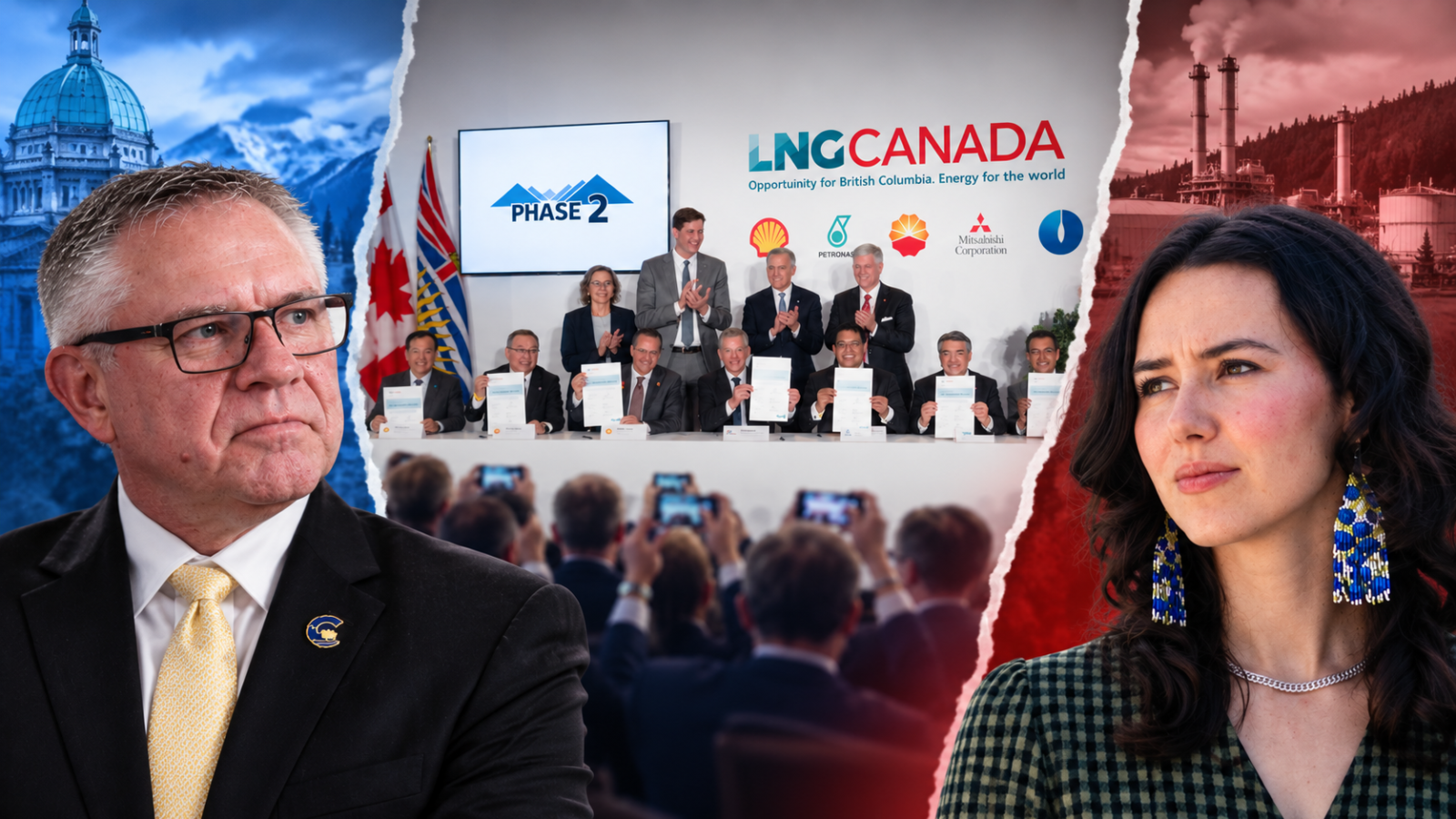

VANCOUVER, B.C. — LNG Canada has reached a final investment decision on its Phase 2 expansion, setting the stage for a major increase in liquefied natural gas production in British Columbia while putting LNG policy at the centre of the province’s 2026 election campaign.
LNG Canada CEO Chris Cooper announced the final investment decision during an event attended by Prime Minister Mark Carney, B.C. Premier David Eby, First Nations leaders, government officials and representatives of LNG Canada’s joint venture partners.
Cooper said Phase 2 will double LNG Canada’s production capacity from 14 million tonnes to 28 million tonnes per year.
“I’m proud to announce that we have taken final investment decision on this nation-building project called LNG Canada Phase 2.”
The company described the decision as a major milestone for the project and for Canada’s energy sector.
More than $30 billion investment
Prime Minister Mark Carney highlighted the scale of the investment, saying the Phase 2 project represents more than $30 billion in investment.
Carney said the expansion will create thousands of jobs and increase Canada’s ability to supply LNG to international markets, including customers in Asia and Europe.
He also said the project will involve a second phase of the Coastal GasLink pipeline, with approximately 2,000 additional pipeline-related jobs.
Carney described the project as an example of cooperation between governments, First Nations, global energy companies, workers and communities.
Up to 4,000 construction jobs
Carney said LNG Canada Phase 2 could create up to 4,000 jobs at peak construction in Kitimat.
The jobs highlighted included welders, pipe fitters, electricians, iron workers, heavy-equipment operators, fabricators and suppliers.
He also said nearly $5 billion in contracts had already been awarded to First Nations and local businesses in the region.
The B.C. NDP, in its September 29 response to the investment decision, similarly said Phase 2 would create up to 4,000 construction jobs and generate an estimated $50 billion for B.C. and Canada over the project’s life. That figure is a party estimate and is presented by the NDP as part of its case for the project.
Indigenous participation and ownership
Indigenous participation was another major theme of the announcement.
Chief Counselor Moren Nice of the Haisla Nation said Phase 2 represents an opportunity for Indigenous communities to participate as owners alongside neighbouring First Nations.
She also emphasized economic development, environmental stewardship, cultural preservation and reconciliation in describing the Haisla Nation’s approach to the project.
The project footprint, including the LNG facility, Coastal GasLink pipeline and shipping route, involves the traditional territories of numerous First Nations.
Eby links project to B.C.’s economic strategy
Premier David Eby said the LNG Canada expansion demonstrates what he described as the economic potential of major projects when governments, industry and First Nations work together.
During the announcement, Eby cited approximately 4,000 high-paying jobs and said the project could generate approximately $28 billion in government revenue over its life.
In a separate September 29 BC NDP statement, the party characterized LNG Canada Phase 2 as the largest private-sector investment in Canadian history and said the project would generate an estimated $50 billion for B.C. and Canada. The party credited Eby’s government, the federal government and LNG Canada with working together to reach the final investment decision.
The NDP also says B.C.’s LNG has a relatively low emissions profile compared with other LNG facilities. In its September 29 statement, the party said emissions from the project are projected to be 35% lower than the world’s best-performing LNG facilities and 60% lower than the global average. Those are figures cited by the NDP and should be understood in that context.
LNG becomes an election issue
The LNG Canada decision comes as B.C. parties campaign ahead of the October 24, 2026 provincial election, and the announcement has produced sharply different responses.
The BC NDP is using the investment decision to argue that its approach to major projects is producing investment and jobs.
The BC Conservatives, meanwhile, say the province should be expanding LNG much more aggressively.
Conservatives propose doubling LNG by 2032 and tripling by 2035
BC Conservative Leader Lorne Doerkson released the party’s BC Energy Superpower Plan on September 28.
The plan calls for B.C. to more than double LNG production by 2032 and triple it by 2035.
The Conservatives also propose a 120-day permitting framework for major projects, harmonizing provincial and federal approvals, designating the liquid-rich Montney Formation as a strategic provincial asset, and creating what the party describes as a more competitive royalty framework.
Doerkson said B.C. has the resources and infrastructure potential to become an energy superpower and argued that the province has not developed enough LNG projects compared with the United States and Qatar.
The Conservative plan also calls for expanded First Nations ownership and partnerships in the energy sector.
NDP challenges Conservative LNG target
The BC NDP responded by arguing that the Conservative target is below the production growth already expected from projects currently under development.
The NDP says B.C. currently has 14 million tonnes per year of LNG production capacity and that five projects either under construction or moving toward final investment decisions would bring the province to nearly 48 million tonnes per year by 2035.
The five projects identified by the NDP are:
- LNG Canada Phase 1 — operational
- Cedar LNG — permitted and under construction
- Woodfibre LNG — permitted and under construction
- LNG Canada Phase 2 — permitted and moving toward FID
- Tilbury Phase 2 and Ksi Lisims LNG — identified by the NDP as projects moving toward FID
The NDP argues that these projects would already put B.C. on a path to more than triple LNG production by 2035.
The two parties therefore frame the same issue differently: the Conservatives argue that B.C. needs a substantially more aggressive energy-development strategy, while the NDP argues that major LNG growth is already underway and that its approach is delivering projects.
Conservatives say B.C. needs more projects
The Conservative Party disputes the NDP’s characterization of the province’s LNG development record.
In announcing its Energy Superpower Plan, the Conservatives said that more than 20 LNG projects had been proposed in B.C. over the years but that only one was operational.
The party argues that permitting delays, regulation and uncertainty have discouraged investment.
Its plan calls for faster approvals and additional infrastructure to support LNG growth.
These are Conservative Party claims about the province’s development record and are part of the party’s election platform.
Greens oppose Phase 2
The BC Greens have taken a fundamentally different position.
Green Party Leader Emily Lowan said September 29 that she was disappointed by the final investment decision and criticized both the NDP and Conservatives for supporting additional oil and gas expansion.
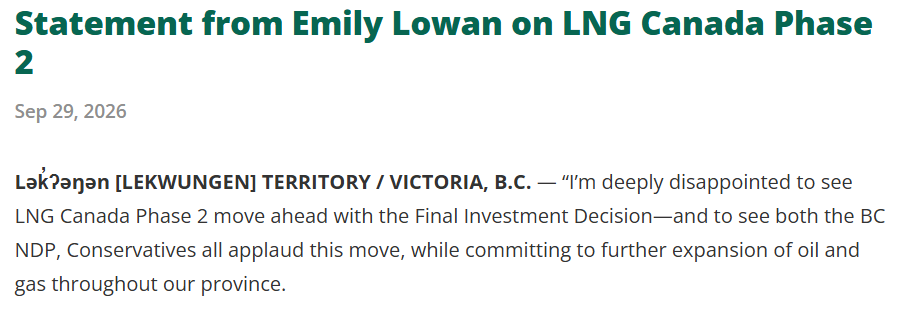
Lowan argued that the benefits of LNG development are overstated and said the Greens would instead prioritize renewable energy and Canadian-owned industries.
She also raised concerns about environmental impacts and Indigenous communities that oppose particular projects.
The Green position therefore differs from both the NDP and Conservatives, which have supported LNG Canada Phase 2 while proposing different approaches to future energy development.
What the LNG debate means for B.C.
The LNG Canada Phase 2 decision has moved beyond a single infrastructure announcement and into a broader election debate about the province’s economic strategy.
The BC NDP is pointing to the project as evidence that its approach can deliver major investment, jobs and energy exports while maintaining environmental and Indigenous-partnership requirements.
The BC Conservatives support LNG Canada Phase 2 but argue that B.C. needs substantially more resource development, faster permitting and a larger LNG industry. Their Energy Superpower Plan targets more than doubling production by 2032 and tripling it by 2035.
The BC Greens oppose the expansion and argue that B.C. should direct investment toward renewable energy and Canadian-owned industries instead.
At the same time, several of the headline numbers being used in the political debate come directly from party statements or government/project proponents and are not all equivalent measures. Production capacity, actual output, construction jobs, permanent jobs, projected government revenue and total economic impact measure different things.
That distinction will likely remain important as B.C. voters hear competing claims about the province’s energy future during the election campaign.
For LNG Canada, however, the immediate outcome is clear: Phase 2 has received its final investment decision, doubling the project’s planned production capacity and moving the expansion into its next stage.
StudioX News | British Columbia

Harnaik Singh Rathor is the Founder, Publisher, and Editor-in-Chief of StudioX News Canada, Canada's multilingual digital news network serving diaspora communities across 44 languages. With a background in media production, public relations, and multicultural communications, he founded StudioX Film and TV Corporation to bridge the gap between mainstream Canadian media and the country's diverse immigrant communities. He is a member of the Canadian Association of Journalists (CAJ), RTDNA Canada, CPRS Vancouver, NEPMCC, and the Canadian Freelance Union (Unifor). Based in Surrey, British Columbia. | LinkedIn: https://www.linkedin.com/in/harnaiksinghrathor/ | Muck Rack: https://muckrack.com/harnaiksinghrathor | Email: editor@studioxnews.ca