
 Add StudioX as a preferred source on Google
Nearly 200 First Nations leaders joined federal, provincial and territorial leaders in Ottawa to discuss economic participation, emergency preparedness, policing and the future of the Indian Act.
OTTAWA — October 26, 2026 — Prime Minister Mark Carney announced new federal funding for First Nations emergency preparedness, policing, community safety and workforce training on Monday, following a meeting with nearly 200 First Nations chiefs and leaders and provincial and territorial premiers.
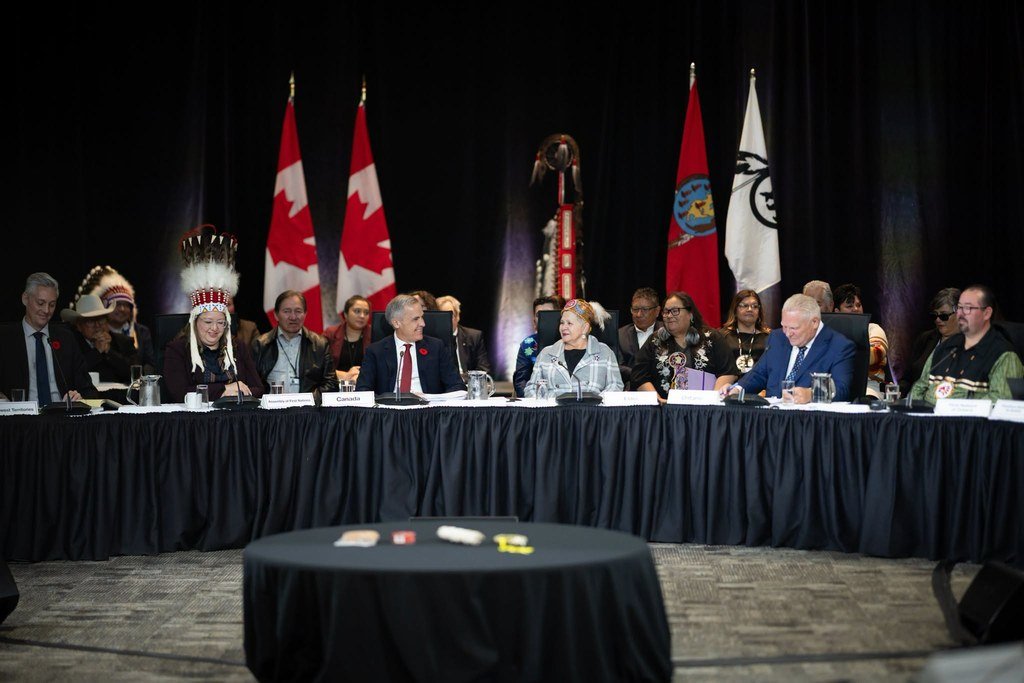
The meeting was the first of its kind in two decades, according to a Prime Minister’s Office news release. Discussions focused on helping First Nations participate directly in the economic benefits of major infrastructure projects, improving community safety and strengthening the relationship between First Nations and governments.
Carney also directed the federal finance minister to work with First Nations leaders on revenue-sharing mechanisms, including the potential creation of a First Nations Sovereign Wealth Fund.
The government said the meeting was intended to advance shared priorities and ensure that federal, provincial and territorial investments deliver practical results for First Nations communities.
First Nations Sovereign Wealth Fund proposed
One of the central outcomes was an agreement to develop new revenue-sharing mechanisms that could give First Nations a more direct financial stake in major Canadian infrastructure and resource projects.
The proposed First Nations Sovereign Wealth Fund is intended to help communities share in the wealth generated by economic development. However, its structure, financing arrangements and implementation timeline have not yet been finalized.
Carney directed the Minister of Finance to work with the Assembly of First Nations, First Nations rights holders and First Nations financial institutions to determine how the proposed fund and other revenue-sharing mechanisms could be established.
The Prime Minister said the proposal originated with the Assembly of First Nations.
“This fund would give First Nations and their children and their children’s children an opportunity to share directly in the wealth that the country is creating,” Carney said during his press conference.
The discussions come as governments pursue major infrastructure and resource projects across Canada. The proposed approach would seek to expand opportunities for First Nations to develop, operate and benefit financially from those projects.
The government has not announced an approved allocation for the proposed fund or confirmed whether it will operate independently or alongside other federal investment initiatives.
Federal government to expand First Nations lending authority
The federal government also announced plans to amend the First Nations Fiscal Management Act to expand the lending authority of the First Nations Finance Authority.
The proposed legislative change is intended to make it easier for First Nations to obtain financing for investments in major infrastructure and resource projects.
The government said the expanded authority would help First Nations participate in projects and share in their financial returns.
The measure forms part of the broader effort to increase Indigenous economic participation and create new revenue opportunities for First Nations communities.
The precise implementation arrangements will depend on the legislative amendments and related financing mechanisms.
$260 million for Indigenous workforce readiness
The federal government announced $260 million over four years to establish the new Partnerships for Indigenous Workforce Readiness Fund.
The fund will provide targeted support to connect Indigenous Peoples with employment opportunities generated by major projects.
Carney also highlighted the government’s $8 billion Team Canada Strong initiative, which aims to train 100,000 skilled trades workers and help them enter job sites faster.
The federal government is developing an Indigenous-focused stream of that initiative to connect Indigenous workers with paid, entry-level trades jobs.
The workforce measures are intended to help Indigenous Peoples access employment opportunities created by infrastructure and resource development while supporting the demand for skilled workers.
Further details on the new fund’s eligibility requirements, delivery arrangements and participating organizations have not been specified in the announcement.
Carney opens process to move beyond the Indian Act
The meeting also addressed the future of the Indian Act, federal legislation dating to 1876 that governs many aspects of the relationship between the Canadian government and First Nations.
Carney said he was committed to establishing a process to move Canada beyond the legislation and had directed federal ministers to work with First Nations to develop a path forward.
The discussions included the possibility of reforming or abolishing the act as part of a broader effort to modernize the Crown’s relationship with First Nations.
However, the government has not announced a decision to repeal the legislation. Carney said any future process would be developed in partnership with First Nations.
Assembly of First Nations National Chief Cindy Woodhouse Nepinak emphasized that First Nations must be able to determine their own path forward.
The discussions are expected to involve complex questions concerning First Nations identity, governance, rights and existing legislative protections. Views on the future of the act differ among First Nations, making consultation and agreement central to the process.
No timetable for completing the work was announced.
More than $2.5 billion for emergency preparedness
The federal government announced more than $2.5 billion over five years, along with nearly $450 million in ongoing funding, to strengthen emergency preparedness and fire protection in First Nations communities.
The funding will be delivered through the Emergency Management Assistance Program, the Wildland-Urban Interface firefighting initiative and the First Nations Fire Protection Strategy.
According to Carney, First Nations communities face significant risks from wildfires, floods and other emergencies.
During his remarks, he said the average number of wildfires affecting First Nations on-reserve communities had more than tripled over the previous 15 years. He also stated that more than 90 per cent of First Nations reserve lands were exposed to flood risk and that people living on reserve were 18 times more likely to be evacuated than those living off reserve.
The announced funding is intended to help communities conduct evacuations, provide emergency assistance and rebuild homes and critical infrastructure following disasters.
It will also support firefighting equipment, protective gear, vehicles and training to improve emergency response capabilities.
The government said the investments are intended to address gaps in emergency preparedness and help communities respond to disasters.
$630 million for policing, plus $250 million annually
The federal government announced more than $630 million over four years, alongside $250 million in ongoing annual funding, to renew and expand agreements under the First Nations and Inuit Policing Program.
According to the government, the agreements are based on a needs-based costing assessment intended to substantially close gaps between First Nations and non-Indigenous police services.
An additional $140 million over four years will support crime prevention and culturally sensitive community safety initiatives in Indigenous communities across Canada.
Carney said community-led policing can help improve public safety when officers understand local needs and have established relationships with the people they serve.
He cited Whitecap Dakota Nation in Saskatchewan as an example of a community that reports a low crime rate despite welcoming more than one million visitors each year.
The funding is intended to strengthen policing services and support locally appropriate crime prevention initiatives.
The practical effects will depend on how the funding is allocated and implemented through agreements and community programs.
Education, housing and clean water remain priorities
The meeting also addressed longstanding gaps in education, housing, health care and essential infrastructure.
In its announcement, the federal government highlighted several existing commitments:
- Education: $3.5 billion annually to help ensure First Nations children on reserves have access to high-quality, culturally safe education.
- Housing: More than $4 billion committed to safe, affordable housing and rental homes for Indigenous communities.
- Clean water: More than $4.5 billion committed to implement the proposed First Nations Clean Water Act and build, maintain and operate water and wastewater infrastructure on reserves.
- Health care: $6 billion annually in culturally safe mental health and primary care services for First Nations, according to the government’s quick facts.
The government said the objective of the meeting and subsequent discussions is to ensure these investments, alongside provincial and territorial contributions, are delivered as effectively as possible.
The federal government also highlighted its work with Modern Treaty partners, including proposed legislation to establish a Commissioner for Modern Treaty Implementation and strengthen federal accountability for treaty commitments.
What happens next?
The announcements establish several areas of work for the federal government and First Nations partners, but important details remain outstanding.
The proposed Sovereign Wealth Fund requires further development, including decisions on its structure, financing and relationship with major projects. Amendments to the First Nations Fiscal Management Act are also planned to expand financing authority.
Federal ministers are expected to work with First Nations on a process addressing the future of the Indian Act. Meanwhile, the newly announced workforce, emergency preparedness and policing funding will need to be translated into programs and agreements.
Carney said the success of the meeting would be measured by the results achieved rather than the frequency of government gatherings.
During the press conference, he said he would like another meeting in approximately two years, with progress on emergency management, policing, economic participation, infrastructure and governance helping to shape the agenda.
The proposed timeline is an intention rather than a confirmed meeting date.
The next phase will test whether the announced commitments translate into increased economic participation, stronger emergency response capacity, improved community safety and measurable progress on longstanding service gaps.
Source: Government of Canada, Prime Minister’s Office, news release dated October 26, 2026, and the Prime Minister’s official opening remarks. Funding amounts and policy commitments are attributed to the federal government. The proposed Sovereign Wealth Fund and potential changes to the Indian Act remain subject to further work with First Nations.
Harnaik Singh Rathor is the Founder, Publisher, and Editor-in-Chief of StudioX News Canada, Canada's multilingual digital news network serving multilingual diaspora communities across Canada. With a background in media production, public relations, and multicultural communications, he founded StudioX Film and TV Corporation to bridge the gap between mainstream Canadian media and the country's diverse immigrant communities. He is a member of the Canadian Association of Journalists (CAJ), RTDNA Canada, CPRS Vancouver, NEPMCC, and the Canadian Freelance Union (Unifor). Based in Surrey, British Columbia. | LinkedIn: https://www.linkedin.com/in/harnaiksinghrathor/ | Muck Rack: https://muckrack.com/harnaiksinghrathor | Email: editor@studioxnews.ca