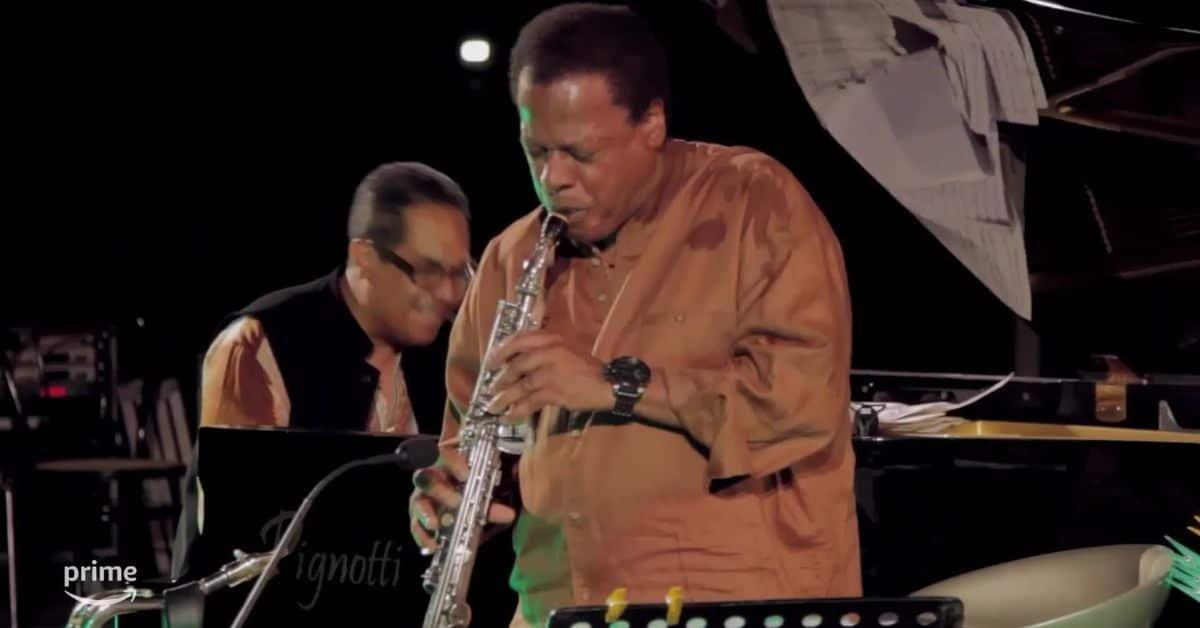

Sonny Rollins, the groundbreaking tenor saxophonist known for his powerful sound and fearless innovation, died Monday at the age of 95. Over a career that spanned more than five decades, Rollins remained one of jazz’s most influential and constantly evolving artists.
His spokesperson, Terri Hinte, confirmed to The Associated Press that Rollins died at his home in Woodstock, New York. No exact cause of death was given, though Hinte said he had been largely confined to his home in recent years because of several health issues.
From his beginnings as a teenage prodigy to his later explorations in free jazz and experimental music, Rollins earned admiration for his unmatched improvisational ability. Alongside John Coltrane and Charlie Parker, he was considered one of the defining saxophonists of the bebop era.
Many rock listeners also became familiar with his work through the Rolling Stones’ 1981 album Tattoo You, which featured Rollins’ memorable saxophone solo on “Waiting on a Friend,” inspired by watching Mick Jagger dance.
Despite his legendary status, Rollins constantly pushed himself artistically. He often stepped away from performing for long stretches and regularly explored new musical directions rather than settling into a familiar style.
He described himself as “a work in progress,” insisting he was never interested in staying confined to a single approach to music.
Although fans especially cherished his early bebop recordings, Rollins rarely revisited them fondly. He once admitted it was “excruciating” to listen to imperfections in his older performances.
“I don’t consider myself a musician that has learned as much as I want to learn,” he told The Associated Press in 2007.
Enduring achievements
During the 1990s and 2000s, Rollins released a series of critically acclaimed albums while maintaining an intense practice routine and touring well into his 80s. Eventually, pulmonary fibrosis — a disease that damages and thickens the lungs — forced him into retirement. His final concert took place in 2012, and by 2014 he had stopped playing altogether.
Though he missed performing for audiences, what he truly longed for was the act of playing itself.
“I played a couple of concerts early on where I was out in the open in the afternoon,” he told The New York Times in 2020. “I was able to look up in the sky, and I felt a communication; I felt that I was part of something. Not the crowd. Something bigger.”
His 2001 album This Is What I Do earned him a Grammy Award for Best Jazz Instrumental Album. In 2006, he won another Grammy for Best Jazz Instrumental Solo for “Why Was I Born?”
That performance appeared on Without a Song: The 9/11 Concert, recorded live in Boston just four days after the September 11 attacks. Rollins, who had evacuated his apartment near ground zero, chose to perform after encouragement from his wife and manager, Lucille, who died in 2004.
He is survived by his nephew, Clifton Anderson, and nieces Vallyn Anderson and Gabrielle DeGroat.
Battle with heroin
Rollins received his first major opportunity as a teenager when he joined Thelonious Monk’s band. Soon after, he performed alongside jazz greats Miles Davis and Bud Powell, entering the recording world before even graduating from high school.
But like many jazz musicians of the late 1940s and early 1950s, Rollins struggled with heroin addiction. He became addicted at 19, and as his dependence worsened, he served two jail terms — 10 months in 1950 and three months in 1953. At one point, he was homeless on the streets of Chicago. In 1954, he admitted himself to a hospital in Lexington, Kentucky, for treatment.
During recovery, Rollins experienced what he described as a spiritual awakening.
“I began to have a deeper philosophy of what life was about,” he told the AP in 2007. “From that point on is when my consciousness awoke.”
After leaving the hospital, he returned to Chicago and joined the Max Roach-Clifford Brown quintet. In 1956, he released Saxophone Colossus, an album whose stripped-down hard bop style cemented his reputation as one of jazz’s elite saxophonists and became one of his defining works.
Over the next two years, Rollins experimented further by performing without a pianist on three landmark albums: Way Out West, A Night at the Village Vanguard, and Freedom Suite.
Then, at the height of his fame, he disappeared from public performance. For two years, he practiced alone on a secluded spot above the East River along the Williamsburg Bridge.
“The thing that I am most proud of in my career is that fact that I was able to see beyond being popular and all that stuff,” he told the AP in 2007, “and do what my inner self told me to do.”
While he was away, jazz shifted toward the more chaotic and energetic sounds of free jazz. When Rollins returned in 1961, he embraced that movement — a decision that divided some fans.
Throughout the mid-1960s, he toured extensively across Europe, moving between traditional jazz and avant-garde experimentation. He also composed original music for the 1966 film Alfie, which helped launch Michael Caine to stardom.
A trip to Japan later introduced Rollins to Zen Buddhism, inspiring another extended break from music that lasted into the early 1970s.
Living legend
When Rollins returned to recording in 1972, he was already regarded as a jazz icon and increasingly embraced by mainstream audiences. That year, he received a Guggenheim Fellowship, and the following year he was inducted into the DownBeat Hall of Fame. He also appeared on The Tonight Show and transitioned from performing in clubs to concert halls.
Born Theodore Walter Rollins in Harlem on Sept. 7, 1930, he grew up in a deeply musical household. His father, a Navy petty officer, played clarinet; his sister played piano; and his older brother was a violinist.
At age eight, his parents encouraged him to study piano, though, as Rollins later joked, “it didn’t take.” He preferred playing baseball outdoors. But by age 11, he had fallen in love with the saxophone and convinced his parents to buy him an alto sax.
Unable to afford many formal lessons, Rollins largely taught himself. He soon switched to tenor saxophone and began performing in clubs while still young.
Rollins also left behind numerous unreleased recordings. Asked what should happen to them after his death, he said he had no intention of leaving instructions.
“After I get out of this planet I’m not going to have any say about what’s going on, so I’m not worried about that,” he told The New York Times in 2020. “And, boy, I agonize over my music; I won’t have to agonize about it anymore. Thank God.”

Harnaik Singh Rathor is the Founder, Publisher, and Editor-in-Chief of StudioX News Canada, Canada's multilingual digital news network serving diaspora communities across 44 languages. With a background in media production, public relations, and multicultural communications, he founded StudioX Film and TV Corporation to bridge the gap between mainstream Canadian media and the country's diverse immigrant communities. He is a member of the Canadian Association of Journalists (CAJ), RTDNA Canada, CPRS Vancouver, NEPMCC, and the Canadian Freelance Union (Unifor). Based in Surrey, British Columbia. | LinkedIn: https://www.linkedin.com/in/harnaiksinghrathor/ | Muck Rack: https://muckrack.com/harnaiksinghrathor | Email: editor@studioxnews.ca