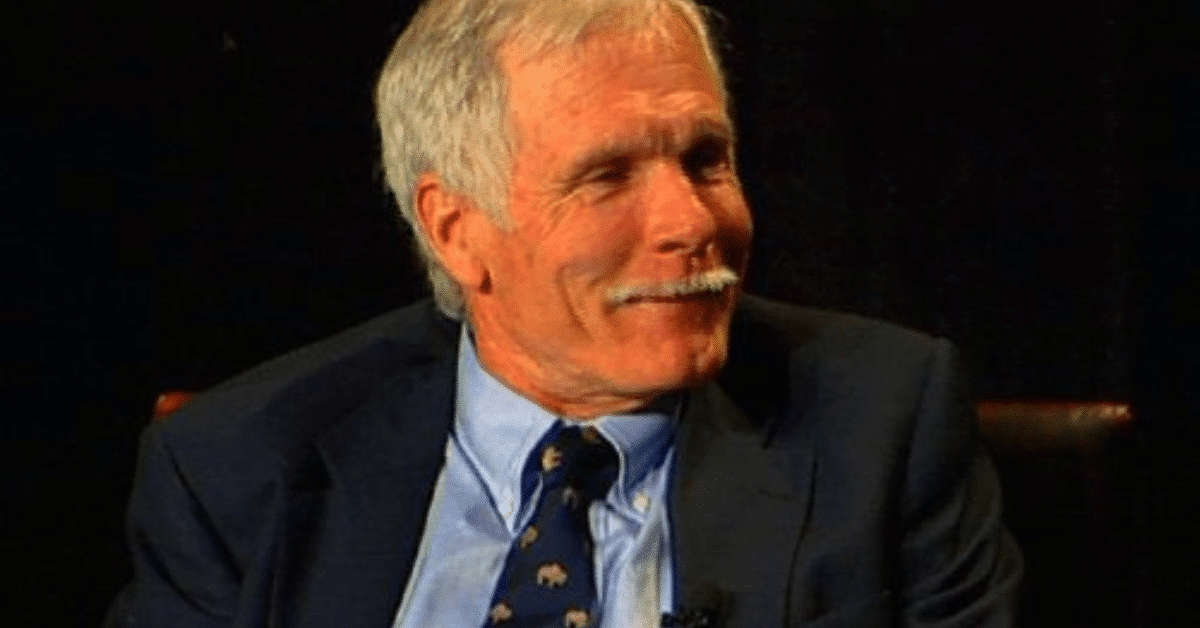

Ted Turner, the outspoken sportsman and entrepreneur whose vision and sharp instincts built a media empire that included the groundbreaking news network CNN, has died at the age of 87, CNN reported on Wednesday, citing a press release from Turner Enterprises.
No cause of death was disclosed. In September 2018, Turner revealed that he had been diagnosed with Lewy body dementia, a degenerative neurological disease. Born Robert Edward Turner III in Cincinnati on November 19, 1938, he moved to the American South with his family at the age of nine. He attended military schools, where he developed into a champion debater and skilled yachtsman.
Turner became a billionaire after taking over his father’s billboard business. In 1970, he purchased a television station and transformed it into a pioneering television empire that later included Turner Classic Movies, TNT, and the TBS SuperStation.
Over the years, Turner emerged as one of the most influential figures in American media and entertainment, with networks focused on news, sports, classic films, and reruns.
He married and divorced three times and was the father of five children. His third marriage, to actress Jane Fonda, lasted a decade before ending in 2001.
On Wednesday afternoon, Fonda shared a heartfelt tribute to Turner on Instagram.
“He swept into my life, a gloriously handsome, deeply romantic, swashbuckling pirate, and I’ve never been the same,” she wrote.
She also reflected on how Turner inspired those around him “to think big (he once asked me to draft a resolution for the UN and the U.S. Congress to ban all nuclear weapons; I did) and act small (for the 20 years since meeting Ted, I too, pick up trash on my walks).”
Fonda, who famously referred to Turner as her “favourite ex-husband,” concluded her tribute by remembering the many wildlife species he worked to protect and speaking about his children.
“If it was complicated to be married to him, think how complicated it was being his child. And they are all doing fine.”
Turner set the standard for 24-hour news
Turner’s defining achievement was launching CNN in 1980 in Atlanta — the world’s first 24-hour all-news television network. He believed it would provide an alternative to what he described as the “sleazy” coverage of major networks CBS, NBC, and ABC.
Today, when news is instantly accessible, it is difficult to imagine how revolutionary the idea once was — allowing viewers to choose when they wanted to consume news.
Despite offering modest salaries, Turner attracted journalists and technical crews with the promise of excitement and innovation. Many outsiders mocked CNN, dismissing it as the “Chicken Noodle Network” and predicting its failure.
Instead, CNN changed global television news forever, becoming the model for live coverage of wars, revolutions, court trials, and natural disasters.
“I was going to have to hit hard and move incredibly fast and that’s what we did — move so fast that the [broadcast] networks wouldn’t have the time to respond, because they should have done this, not me,” Turner recalled in a 2016 interview with the Academy of Achievement.
“But they didn’t have the imagination.”
CNN’s breakthrough came during the 1991 Gulf War.
While most television journalists fled Iraq amid warnings of an imminent American attack, CNN remained on the ground. The network broadcast dramatic footage of the opening strikes, with anti-aircraft fire lighting up the night sky as correspondents reacted live to nearby explosions.
Turner was promised a continued role in CNN after selling his company to Time Warner for $7.3 billion in stock. However, he was gradually sidelined — something he later deeply regretted.
“I made a mistake,” he once admitted. “The mistake I made was losing control of the company.”
That same year, 1996, also marked the launch of Fox News Channel and the rise of Rupert Murdoch as a dominant force in cable news. Over time, political opinion became central to networks such as Fox News and MSNow (formerly MSNBC).
The ‘presiding spirit of CNN’
Veteran CNN correspondent Christiane Amanpour remembered Turner as a towering figure.
“He said it like it was and like it is, and we were his willing foot soldiers. And I think he changed not just the world, but all of our lives, too,” she said.
“He was always and will be the presiding spirit of CNN,” CNN Worldwide chairman and CEO Mark Thompson said in a statement.
But Turner’s ambitions extended far beyond CNN. He acquired the MGM/UA movie studio before making an even bigger move by merging Turner Broadcasting System with Time Warner in 1996.
Although Turner became head of the company’s cable networks division and remained its largest shareholder, he struggled to adapt to corporate management after decades of operating independently. Eventually, he lost control of the networks he had built.
U.S. President Donald Trump reacted to Turner’s death by calling him “one of the Greats of All Time.”
“Whenever I needed him, he was there, always willing to fight for a good cause!” Trump wrote on social media.
The Braves’ billionaire owner
Turner also built a major sports empire and at one point owned professional baseball, basketball, and hockey teams in Atlanta. He was perhaps best known for his ownership of the Atlanta Braves, helping transform the struggling MLB franchise into a consistent postseason contender during the 1990s.
The team’s stadium, built for the 1996 Olympics, was named Turner Field in his honour before the Braves moved to a newer stadium in 2016.
“Our good friend and former owner, Ted Turner, was one of a kind — a brilliant businessman, consummate showman and passionate fan of his beloved Braves,” the team posted on X.
“Ted’s visionary leadership and innovative approach to broadcast television transformed the Braves into ‘America’s Team.’ Under his stewardship, the ballclub experienced one of the greatest runs of sustained excellence in Major League Baseball history and brought a World Series championship to Atlanta in 1995.”
A passion for land, wildlife and philanthropy
Beyond business and sports, Turner had a deep love for the land. He acquired millions of acres of ranchland, complete with roaming buffalo herds, and became Nebraska’s largest private landowner.
He frequently spoke about restoring America’s bison population and, in 2002, launched the restaurant chain Ted’s Montana Grill, known for its bison burgers.
Researchers at Texas A&M University later credited Turner’s donation of several bulls in 2005 with improving the genetic diversity of the last southern Plains bison herd.
Though his net worth stood at $2.5 billion in 2023, Turner had dropped off Forbes’ list of the 400 richest Americans in 2021.
He devoted much of his wealth and energy to causes such as world peace and environmental protection.
“My life is more an adventure than a quest to make money. Adventure is going out and doing something for the pure hell of it,” Turner once said. “You just want to see if you can do it, period. There’s no thought of gain other than your own satisfaction.”
In 1997, Turner made headlines around the world by pledging $1 billion to support United Nations operations. After completing the final installment in 2017, he described it as “the best investment I’ve ever made.”
UN Secretary-General António Guterres called Turner “a visionary whose conviction, generosity & audacious spirit left a lasting imprint on the UN & our world.”
New York Times columnist Nicholas Kristof wrote, “He revolutionized philanthropy.”
“Before him, rich people gave to museums, universities, churches. They spent more money buying paintings of women than actually helping women or girls.”
Kristof added that Turner’s donation to the UN “started a competition among tycoons to be more philanthropic and led many more to try to help the needy. He made giving cool, and he saved countless lives.”
Turner’s foundation also donated millions to environmental groups while he continued investing in clean energy initiatives.
Concerned about nuclear conflict, he co-founded the Nuclear Threat Initiative in 2001, a nonprofit dedicated to reducing the dangers posed by nuclear, biological, and chemical weapons.
Turner often spoke openly about global threats.
“If I had to predict, the way things are going, I’d say the chances are about 50-50 that humanity will be extinct in 50 years,” he said in 2003.
“Weapons of mass destruction, disease, I mean this global warming is scaring the living daylights out of me.”
Despite his global philanthropy, Turner was equally known for small acts of generosity. He once donated $500 to a volunteer fire department that helped control a blaze on one of his ranches, and on another occasion lent personal paintings to a museum exhibition in Bozeman, Montana.

Harnaik Singh Rathor is the Founder, Publisher, and Editor-in-Chief of StudioX News Canada, Canada's multilingual digital news network serving diaspora communities across 44 languages. With a background in media production, public relations, and multicultural communications, he founded StudioX Film and TV Corporation to bridge the gap between mainstream Canadian media and the country's diverse immigrant communities. He is a member of the Canadian Association of Journalists (CAJ), RTDNA Canada, CPRS Vancouver, NEPMCC, and the Canadian Freelance Union (Unifor). Based in Surrey, British Columbia. | LinkedIn: https://www.linkedin.com/in/harnaiksinghrathor/ | Muck Rack: https://muckrack.com/harnaiksinghrathor | Email: editor@studioxnews.ca