StudioX News | October 15, 2026
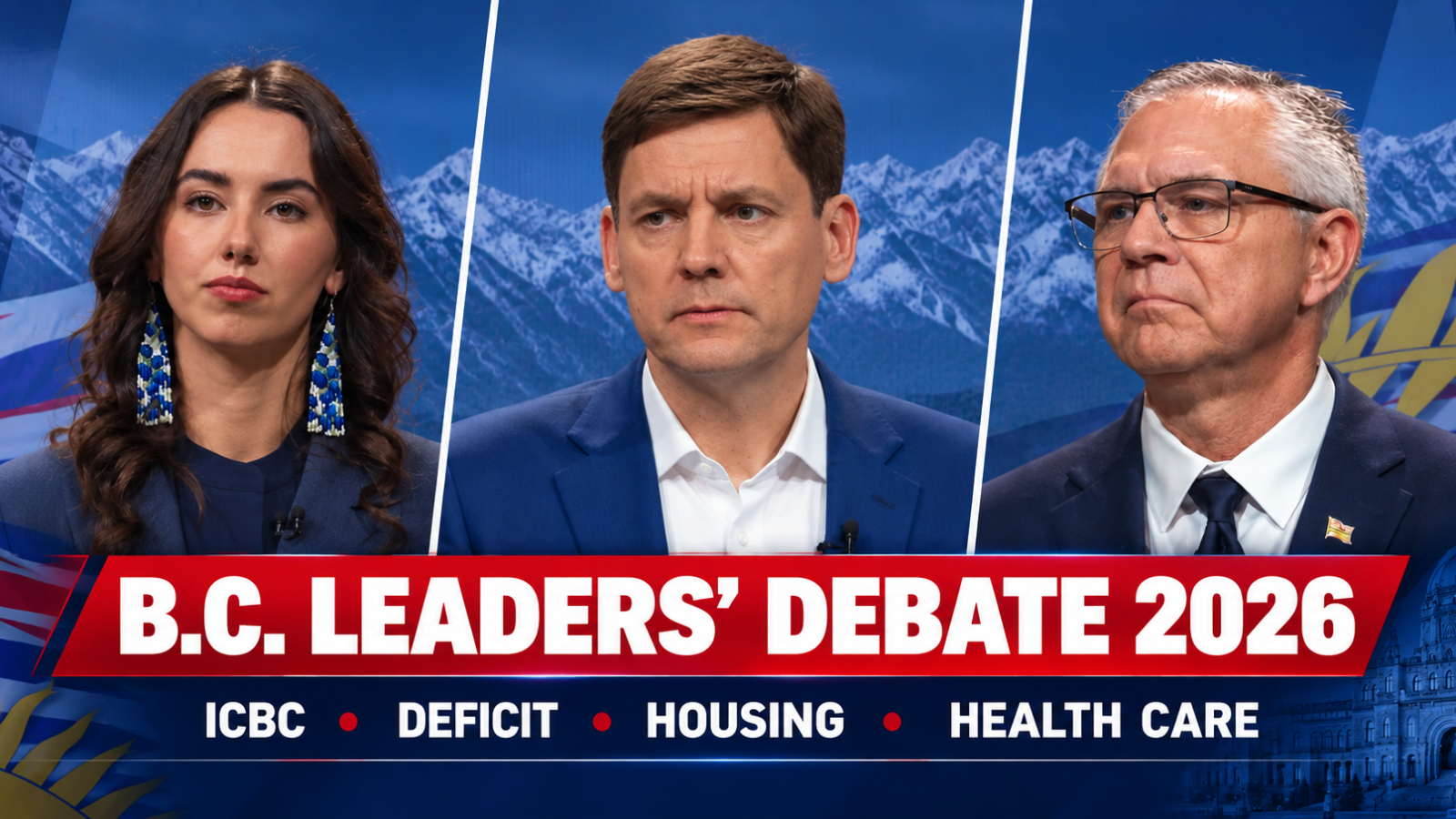
VANCOUVER, B.C. — British Columbia’s major party leaders clashed over the province’s finances, auto insurance, housing affordability, health care, public safety and Indigenous rights during the only live televised leaders’ debate of the provincial election campaign on Wednesday night.
B.C. NDP Leader David Eby defended his government’s record after nearly nine years in office, while B.C. Conservative Leader Lorne Doerkson argued that the province needs a change in direction. B.C. Green Party Leader Emily Lowan challenged both larger parties, criticizing their approaches to the economy, housing, health care and environmental policy.
Moderated by Shachi Kurl, the debate gave voters an opportunity to compare the leaders’ priorities and examine how their campaign promises would be funded and implemented ahead of the October 24 provincial election.
The exchanges repeatedly returned to a central question: How will the next government pay for its promises while addressing affordability, maintaining public services and managing the province’s deficit?
The debate also featured sharp exchanges over ICBC, party controversies and the Declaration on the Rights of Indigenous Peoples Act (DRIPA). Although the leaders outlined competing visions, questions remained about the details, costs and timelines behind several of their proposals.
Deficit and taxes: Competing promises, unanswered questions
The province’s finances were among the debate’s most consequential issues. The moderator cited a $13.8-billion deficit, pressing Eby to explain how the province moved from a substantial surplus to a large projected shortfall.
Eby defended his government’s spending, arguing that public services and infrastructure had required investment. He contrasted the NDP’s record with previous governments, pointing to schools that had been opened or expanded and hospital projects undertaken during his party’s time in office.
Eby argued that earlier balanced budgets had come at a cost to public services. His defence centred on the position that the government had continued spending to maintain essential services amid economic uncertainty and trade-related pressures.
Doerkson used the deficit to challenge the NDP’s economic management. The Conservatives have argued that government spending and bureaucracy need to be reduced and that stronger economic growth would improve the province’s fiscal position.
However, the exchange left questions about which expenditures a Conservative government would reduce, how quickly those reductions would take effect and how the party would balance its spending priorities with its promise to lower taxes.
The Conservative platform includes a proposed $1,000 tax reduction through an increase in the basic personal income-tax exemption from $13,216 to $32,000. The party has argued that its economic approach would support growth, but its broader strategy for eliminating the deficit remains a key question for voters.
Eby, meanwhile, has proposed increasing provincial income-tax rates on higher earners if re-elected. The NDP says the changes would raise approximately $1 billion annually to help fund health care and reduce costs.
Under the proposal described during the campaign, the tax rate would rise by two percentage points in the existing top two provincial income-tax brackets, with a new bracket for income above $1 million taxed at 24.5 per cent. The NDP says the changes would affect fewer than four per cent of income earners and apply to income above the relevant thresholds.
Lowan argued for a different approach: a wealth tax on ultra-wealthy individuals with fortunes exceeding $50 million. She rejected concerns that the measure would necessarily drive wealthy residents out of the province and argued that the revenue could support public services, housing and other social programs.
During the debate, Lowan cited revenue estimates of $22.2 billion in the first year and approximately $5.4 billion in subsequent years. Those figures were presented as part of her party’s proposal and should be assessed against the plan’s precise design, assumptions and independent fiscal costing.
The debate did not establish a fully costed, near-term path from any party to eliminating the projected deficit.
For voters, the distinction is important: a tax cut, a tax increase or a new revenue source is a campaign proposal, not proof that the resulting budget will balance. The parties’ plans must ultimately be assessed against their costs, economic assumptions and effects on public services.
ICBC: The debate’s sharpest policy test
Auto insurance emerged as one of the most contentious subjects of the evening, with Eby and Doerkson defending fundamentally different approaches to the Insurance Corporation of British Columbia.
The NDP has promised to freeze ICBC rates for another three years. It argues that the public insurer’s current system helps keep basic insurance affordable and warns that changes allowing more lawsuits could increase legal expenses and place upward pressure on premiums.
Doerkson has proposed changes to the province’s no-fault auto-insurance system, including allowing lawsuits in a wider range of circumstances and limiting lawyers’ fees. He has argued that his approach would give injured people greater access to legal remedies while keeping insurance rates competitive.
Eby challenged the Conservatives to explain how the proposed changes would affect premiums. He argued that opening the door to more litigation could increase costs for the public insurer and, ultimately, drivers.
The NDP and supporters of the existing system have warned that premiums could rise substantially under the Conservative proposal. The party has also cited concerns that some drivers could face much higher costs. Those predictions remain campaign claims unless supported by transparent, comparable actuarial modelling.
Doerkson defended the broader direction of his proposal but faced continued questions about the specific effect on rates. His commitment to competitive premiums was not the same as an unconditional guarantee that rates would remain frozen or fall by a defined amount.
The exchange highlighted a practical issue for drivers: changing the rules around lawsuits, compensation and legal costs can have financial consequences, but the scale of those consequences needs to be demonstrated.
Voters should look for a clear comparison of the parties’ proposals, including projected premiums, claims costs, compensation for injured people, administrative expenses and the treatment of different categories of drivers.
Affordability: Gas, groceries and taxes
Eby used the debate to present the NDP as the party offering direct measures to address household costs. The party’s post-debate statement highlighted several commitments, including temporary relief at the gas pump, an extension of its ICBC rate freeze and proposed protections against price increases on selected grocery staples.
The NDP says its gas-tax proposal could save drivers up to 30 cents per litre, or as much as $20 per tank, depending on the vehicle and amount purchased. The exact savings would depend on the proposal’s implementation and the amount of fuel purchased.
The party has also promoted a price guard covering milk, eggs, cheese, butter and poultry. The proposal is intended to address the cost of essential groceries, although the practical details—including how prices would be monitored, how the measure would be enforced and how suppliers and retailers would be affected—are important to its assessment.
Eby also linked his proposed higher-income tax rates to funding health care and lowering costs.
Doerkson’s affordability message focused on tax relief and changing the province’s economic direction. His proposed increase to the basic personal income-tax exemption is intended to leave more money in taxpayers’ hands.
Lowan argued that affordability cannot be addressed through tax cuts alone. The Greens have linked their proposals for wealth taxation to investments in areas such as child care, transit and social housing.
The three approaches reflect different assumptions about how government can improve household finances: targeted price measures and public spending, lower personal taxes and economic growth, or increased taxation of extreme wealth to fund public services.
The debate did not provide a common framework for comparing the total financial impact of these plans on households with different incomes, family sizes and housing situations.
Health care: Access, recruitment and long-term care
Health care remained a major point of disagreement, with each leader presenting a different explanation for the province’s challenges.
Eby defended the NDP’s record and highlighted efforts to recruit doctors, including a program intended to bring more physicians from the United States into B.C.’s health system with fewer regulatory barriers. The NDP has cited approximately 800 health-care workers recruited from the United States and the development of a new medical school at Simon Fraser University in Surrey.
The party has also said more than one million additional people have been connected to a family doctor under its government.
Those claims are relevant to the debate over access, but the terms matter. The number of people connected to a family doctor, the number of workers recruited and the number of providers actively delivering care are different measures. A complete assessment requires information about how the figures are defined, how many recruited professionals have begun practising and whether patients can obtain timely appointments.
Eby also proposed hospital-like care in people’s homes for 5,600 seniors and free shingles vaccinations through Pharmacare.
Doerkson said he supported a universal, publicly funded health-care system and rejected suggestions that a Conservative government would abandon that principle. He emphasized the need to address staffing, workplace safety and access to care.
Lowan questioned the NDP’s credibility on health care, pointing to spending on private agency nurses and the cancellation of long-term-care projects. She argued that the province needed a stronger commitment to publicly delivered care and long-term planning.
The leaders’ exchange also raised questions about the cost and delivery of seniors’ care. Eby said work on certain long-term-care projects had been halted after costs increased substantially and that a review had brought spending under control. Doerkson challenged the government over projects that had not proceeded as originally expected.
The broader issue is not simply how much a party promises to spend. Voters need to know how many additional care spaces will be delivered, when they will open, how staffing will be secured and how the plans will reduce waiting times for patients and families.
Housing: Supply, municipal rules and unsold homes
Housing affordability was another central theme, with all three leaders acknowledging the pressure facing renters and prospective buyers but offering different approaches.
Eby defended the NDP’s housing record and pointed to a reported 24 consecutive months of declining rents. He attributed the trend in part to the construction of additional rental housing and government measures intended to increase supply.
However, rent movements cannot be attributed to a single policy without further analysis. Housing supply is one factor; demand, population changes, economic uncertainty and shifts in the rental market can also influence prices.
Eby also defended the government’s use of provincial rules to require municipalities to approve more housing. He argued that removing those requirements, as the Conservatives have proposed, could create additional uncertainty and return some developments to lengthy approval processes.
Doerkson said municipalities should have greater control over local planning and criticized what he described as excessive provincial interference. He argued that builders face unnecessary delays and that improving relationships between the province and municipalities could help homes get built faster.
The NDP has also proposed a two per cent tax on newly built, unsold condominium units and has discussed expanding the speculation and vacancy tax.
The proposal raises questions about its intended effect, including whether it would encourage units to be sold or rented, how it would affect developers and buyers, and whether its design would discourage new construction.
Lowan promoted a different set of housing measures, including vacancy control, changes to pet restrictions in rental housing and restoring support for low-income and non-profit housing.
The debate exposed a familiar tension in B.C. housing policy: governments want to increase supply while also discouraging practices they believe keep homes out of use or make housing less affordable. The effectiveness of each measure depends on its design, enforcement and interaction with broader market conditions.
For renters and homebuyers, the most useful test will be whether the proposals result in more homes, lower costs and shorter waits—and how quickly those changes can realistically occur.
Public safety: Promises must be matched with funding
Public safety provided another test of the parties’ spending commitments.
Doerkson called for stronger action against crime, including more resources for police and prosecutors, treatment and mental-health services. He has argued that communities need a more effective response to repeat and violent offenders.
But the discussion returned to the question of how those commitments would be funded alongside the Conservatives’ tax-cut proposals and pledge to reduce government spending.
The challenge for any government is to identify which services would receive additional resources, how many personnel or treatment spaces would be added, and where the money would come from.
Eby defended his government’s approach, including involuntary care for people who meet the applicable criteria, and argued that public safety must be considered alongside health and social services.
Lowan emphasized public-health responses, housing and support services, arguing that enforcement alone would not address the underlying causes of many community-safety problems.
The parties’ approaches differ, but the debate did not fully resolve how they would measure results. Voters will need details on staffing, treatment capacity, prosecution timelines and the evidence behind each proposed intervention.
It is also important to distinguish between violent offending, addiction, mental illness and homelessness. These issues can overlap, but they are not interchangeable and do not all call for the same response.
DRIPA: Repeal, implementation and legal certainty
The Declaration on the Rights of Indigenous Peoples Act, commonly known as DRIPA, produced another heated exchange.
Doerkson has promised to repeal the legislation, arguing that changes are needed to provide certainty around land, resource development and the province’s legal framework. His position has placed the Conservatives at odds with the NDP and Greens over how B.C. should implement its commitments concerning Indigenous rights.
Eby defended the need to address legal uncertainty while arguing that the province must work with Indigenous communities and consider the implications of court decisions. The debate touched on litigation involving Indigenous rights and land, including the Gitxaała and Cowichan Tribes cases.
The legal issues surrounding Indigenous rights, title, consultation and provincial legislation are complex. A party’s campaign position on DRIPA should not be treated as a complete explanation of the legal effect of the act or of any individual court ruling.
Lowan argued that DRIPA has no bearing on private property in the way some political arguments suggest. She accused the other leaders of engaging in bad-faith arguments and defended continued implementation of the legislation.
The exchange left questions about what would replace DRIPA if it were repealed, how the province would address existing legal obligations and what framework the parties would use to provide certainty for Indigenous communities, property owners and resource developers.
Those questions matter beyond the campaign. Any proposed repeal or amendment would need to explain the legal and practical consequences, rather than relying solely on broad assurances about certainty or rights.
Party controversies dominate parts of the debate
The leaders also exchanged personal and political attacks, at times shifting attention away from policy.
Eby raised controversy involving Conservative campaign manager Katy Merrifield over an anti-Islamic social-media post that was later removed. Doerkson responded by criticizing Eby’s handling of his own caucus and referring to the departure of former NDP minister Selina Robinson after controversy over her comments concerning the Israeli-Palestinian conflict.
Doerkson also attacked Eby’s work as a legal advocate before entering politics.
Lowan criticized the exchange as an example of the dysfunction she says affects the legislature.
The debate later included criticism involving Conservative MLA Heather Maahs and her conduct toward Centre BC Leader Elenore Sturko. These allegations and characterizations should be understood as claims made in the political exchange, not as independent findings established by the debate itself.
The confrontations underscored how controversies involving party officials, candidates and past political decisions can become central campaign issues. They also illustrated the difficulty of keeping a debate focused on voters’ questions about the cost of living, public services and the province’s future.
LNG and the economy: Growth versus environmental risk
The debate also addressed the province’s economic future and its reliance on resource development.
Lowan challenged Eby over liquefied natural gas, asking why the province should risk its economic future on LNG projects. The Greens have argued that B.C. should prioritize climate action and avoid making long-term economic decisions that could leave the province exposed to environmental and market risks.
Eby defended the NDP’s approach to resource development and partnerships, arguing that economic activity and investment must be considered alongside the province’s broader priorities.
The exchange reflected a wider disagreement about how B.C. should create jobs, generate revenue and meet climate objectives.
The practical questions include the expected public revenue from individual projects, the infrastructure and environmental costs, the risk of changing global demand and the long-term implications for workers and communities.
Campaign statements about the economic benefits or risks of LNG need to be evaluated against project-specific evidence and transparent assumptions.
Centre BC and OneBC leaders appear in recorded messages
Centre BC Leader Elenore Sturko and OneBC Leader Dallas Brodie did not participate in the live leaders’ debate. Recorded messages from both leaders were shown at the end of the broadcast.
Sturko has described Centre BC as fiscally responsible and socially progressive, positioning the party as an option for voters who do not feel represented by the NDP or Conservatives.
Brodie outlined OneBC’s proposals, including a 25 per cent income-tax cut and a two-percentage-point reduction in the provincial sales tax.
Because the two leaders did not take part in the live exchanges, their recorded statements did not provide the same opportunity for the moderator or other leaders to question the details of their proposals.
The cost, implementation and fiscal implications of the tax reductions would need to be assessed against the parties’ full platforms.
After the debate, the NDP declared Eby the winner
In a post-debate statement issued on October 14, the B.C. NDP described Eby as the clear winner, emphasizing his positions on affordability, health care and the economy. The party also circulated a collection of favourable reactions from commentators, journalists, academics, political figures and other observers.
The statements included positive assessments of Eby’s command of policy and criticism of Doerkson’s answers on costing and ICBC.
Global News commentator Keith Baldrey was quoted as saying that Eby appeared to be the person “in charge of the room.” University of the Fraser Valley political scientist Hamish Telford was quoted as assessing Eby as stronger on command of policy and calling for more specifics and detail from Doerkson.
Other reactions highlighted the Conservative leader’s difficulty, in the observers’ view, explaining how his promises would be funded without cuts to essential services. Some commentators also criticized his handling of the ICBC discussion.
These reactions provide one perspective on how the debate was received, but the NDP’s list was selected and distributed by the party itself. It is not a comprehensive or independent survey of media opinion, and it does not establish an objective winner.
Some of the individuals quoted also have identifiable political roles or affiliations. Their comments should be understood in that context, and exact quotations should be checked against the original broadcast, publication or social-media post before republication.
Ultimately, a debate performance is only one part of an election campaign. Policy detail, credibility, affordability, public-service delivery and voters’ assessments of each party’s record will all contribute to the result.
Seven questions voters still need answered
The debate brought competing proposals into sharper focus, but several practical questions remain for voters ahead of October 24:
- The deficit: What are each party’s full fiscal projections, and how will its spending, tax and growth assumptions affect the provincial budget?
- ICBC: What would each proposed insurance model mean for premiums, compensation, legal costs and drivers with different claims histories?
- Family doctors: How many additional patients will receive ongoing access to a primary-care provider, and on what timeline?
- Long-term care: How many new care spaces will be delivered, when will they open and how will they be staffed?
- Housing: Which measures are expected to produce more homes or lower rents, and what evidence supports those projections?
- Public safety: How will proposed investments in policing, prosecution, treatment and mental-health services be funded and evaluated?
- DRIPA: What specific legal and policy framework would each party use to address Indigenous rights, property concerns and certainty for development?
These questions move the campaign beyond slogans and toward measurable commitments.
The bottom line
Wednesday’s debate offered a clear contrast between the leaders’ visions for British Columbia. Eby defended the NDP’s record and promoted targeted affordability measures and additional health-care investment. Doerkson argued that the province needs a change in direction, lower taxes and a different approach to public spending, auto insurance and regulation. Lowan challenged both parties, advocating wealth taxation and stronger commitments to social programs and environmental priorities.
But the most consequential test is not simply who delivered the strongest lines on stage. It is whether the parties can demonstrate that their promises are financially credible, legally workable and capable of producing measurable results.
With the October 24 election approaching, voters will need to examine not only what each leader promises, but also what those promises will cost, how they will be delivered and what trade-offs may be required.
StudioX News will continue examining the parties’ platforms, campaign claims and policy commitments as British Columbians prepare to vote.

Harnaik Singh Rathor is the Founder, Publisher, and Editor-in-Chief of StudioX News Canada, Canada's multilingual digital news network serving diaspora communities across 44 languages. With a background in media production, public relations, and multicultural communications, he founded StudioX Film and TV Corporation to bridge the gap between mainstream Canadian media and the country's diverse immigrant communities. He is a member of the Canadian Association of Journalists (CAJ), RTDNA Canada, CPRS Vancouver, NEPMCC, and the Canadian Freelance Union (Unifor). Based in Surrey, British Columbia. | LinkedIn: https://www.linkedin.com/in/harnaiksinghrathor/ | Muck Rack: https://muckrack.com/harnaiksinghrathor | Email: editor@studioxnews.ca