Early unofficial results from Alberta’s October 19 referendum show majority support for increased provincial control over immigration, while voters are also favouring the option to keep Alberta within Canada rather than begin the legal process toward a future separation referendum.
The results, published by Elections Alberta and last updated at 1:01 a.m. on October 20, remain preliminary. At that time, 2,400 of 5,586 voting areas and locations had reported, with 3,186 still listed as not reported. The election authority has scheduled the official results for October 29.
Remaining in Canada leads on the separation question
On Question 10, voters were asked whether Alberta should remain a province of Canada or whether the provincial government should begin the legal process required to hold a binding referendum on separation.
The unofficial tally showed:
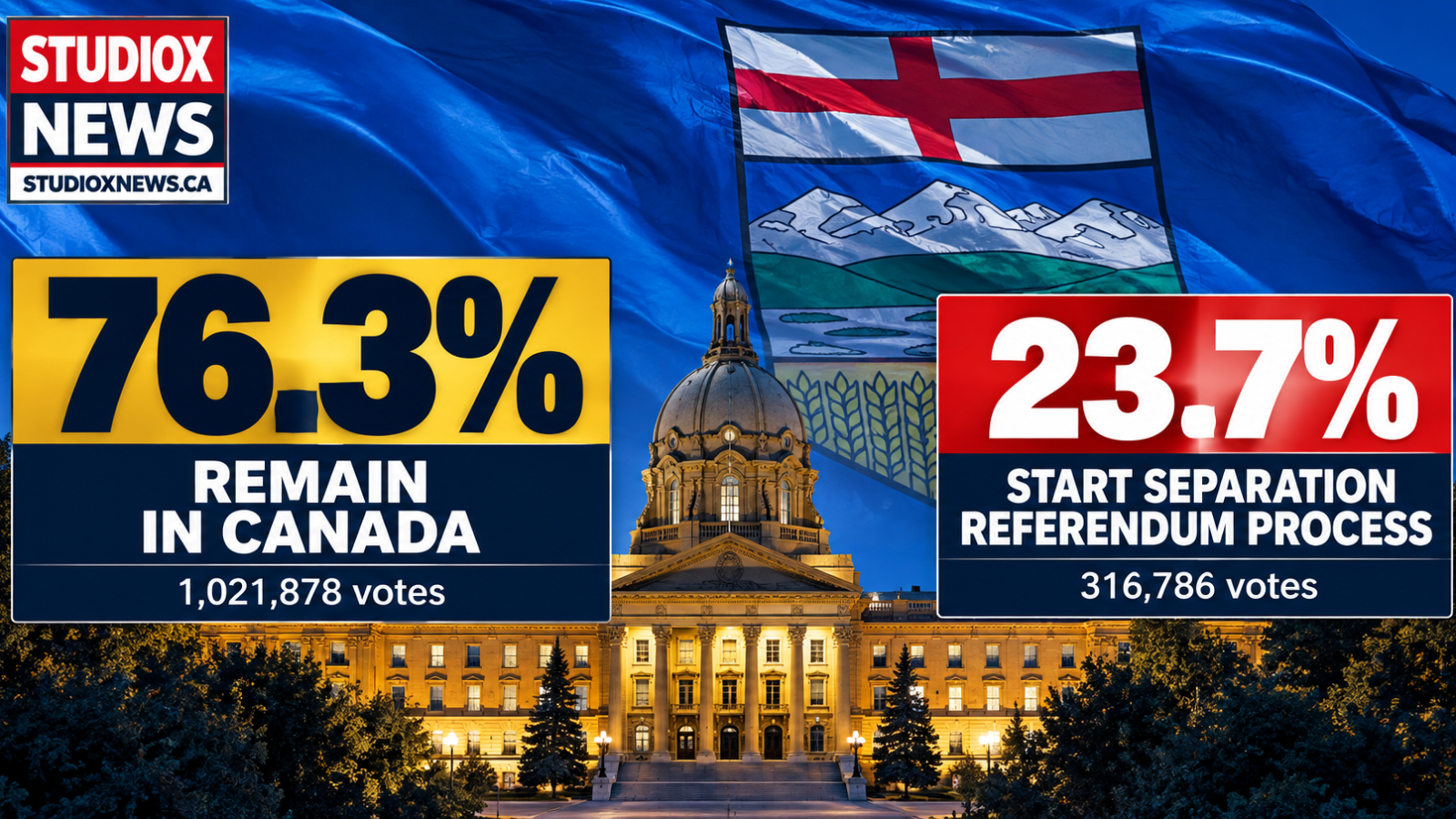
- Remain in Canada: 1,021,878 votes
- Begin the process toward a separation referendum: 316,786 votes
- Total votes reported for the question: 1,338,664
The remain option had approximately 76.3 per cent of the reported vote, compared with 23.7 per cent for beginning the process toward a future referendum.
The question did not ask Albertans to vote directly on independence. Instead, it asked whether the government should commence the constitutional process required for a future binding referendum on whether Alberta should separate from Canada.
That distinction is important when interpreting the results. The vote reflects support for one of two proposed next steps, not a direct decision to declare independence.
Immigration proposals receive majority support in early results
The first four referendum questions focused on immigration policy, access to provincially funded programs, residency requirements and possible fees for certain non-permanent residents.
Question 1: Increased provincial control over immigration
The proposal to give Alberta greater control over immigration, reduce immigration to more sustainable levels, prioritize economic migration and give Albertans first priority for new employment opportunities received 363,509 Yes votes against 273,199 No votes.
That represents approximately 57.1 per cent support among the votes reported for the question.
Question 2: Eligibility for provincially funded programs
A proposal to restrict eligibility for provincially funded programs, including healthcare, education and social services, to Canadian citizens, permanent residents and individuals with an Alberta-approved immigration status received 291,259 Yes votes and 231,781 No votes.
Approximately 55.7 per cent of the reported votes supported the proposal.
Question 3: A 12-month residency requirement
A proposal requiring people with non-permanent legal immigration status to reside in Alberta for at least 12 months before qualifying for provincially funded social support programs received 222,470 Yes votes and 168,745 No votes.
The Yes side held approximately 56.9 per cent of the reported vote.
Question 4: Possible fees for healthcare and education
A proposal to charge a reasonable fee or premium to non-permanent residents for their own and their families’ use of healthcare and education systems received 165,919 Yes votes and 130,535 No votes.
Approximately 56 per cent of the reported votes supported the proposal.
These figures indicate early support for all four proposals. They do not, by themselves, establish that any proposed policy has become law. The referendum results are unofficial, and the legal and practical implications of any government action would depend on the applicable constitutional and legislative requirements.
Voter identification proposal also leads
Question 5 asked whether Alberta should require individuals to provide proof of citizenship, such as a passport, birth certificate or citizenship card, when voting in a provincial election.
The proposal received 128,432 Yes votes and 83,979 No votes, giving the Yes side approximately 60.5 per cent of the reported vote.
The result suggests support for a citizenship-document requirement among voters whose ballots had been counted at the time of the update.
Constitutional questions produce closer results
The remaining questions addressed the selection of provincial court justices, the future of the Senate and the balance of power between provincial and federal governments.
On Question 6, which proposed working with other provinces to amend the Constitution so provincial governments could select justices appointed to provincial King’s Bench and Appeal courts, the Yes side led by 67,790 votes to 67,120.
Question 7, concerning the abolition of the unelected federal Senate, also showed a narrow Yes lead: 74,416 votes to 70,672.
Question 8 asked whether provinces should be allowed to opt out of certain federal programs affecting provincial jurisdiction without losing associated federal funding. The No side led, with 66,728 votes against 60,435 Yes votes.
Question 9 proposed giving provincial laws priority over conflicting federal laws in provincial or shared areas of constitutional jurisdiction. The No side led with 80,734 votes, compared with 78,801 Yes votes.
These margins were considerably narrower than those recorded on several immigration-related questions. They should be treated as preliminary until the official count is complete.
Advance voting accounts for most ballots reported
Elections Alberta reported 3,965,188 valid votes cast across the ten questions at the time of the update. The number represents valid votes across multiple ballot questions, not a count of unique voters.
The reported vote totals by voting opportunity were:
- Advance voting: 2,530,535 valid votes, approximately 63.82 per cent of the reported total.
- Election Day: 857,043 valid votes, approximately 21.61 per cent.
- Special ballots: 514,387 valid votes, approximately 12.97 per cent.
- Mobile voting: 63,223 valid votes, approximately 1.59 per cent.
Advance voting accounted for the largest share of reported valid votes. However, reporting completion varied by voting opportunity, and thousands of voting areas and locations remained unreported.
Elections Alberta also cautions that a voting area or location is considered reported once at least one question from that location has been submitted. Therefore, the reporting percentage does not necessarily mean every question from every reported location has been fully counted.
What happens next?
The unofficial figures offer an early indication of voter sentiment on immigration, provincial powers and Alberta’s relationship with Canada. But the final outcome must be assessed after the official count.
The results also demonstrate why the ten questions should be considered individually. Support for increased provincial control over immigration does not automatically establish support for every constitutional proposal, while the lead for remaining in Canada is separate from the results on the other nine questions.
Elections Alberta has scheduled the official results for Thursday, October 29, 2026.
StudioX News will continue to follow the official count and the policy implications of the referendum proposals.
Source: Elections Alberta, 2026 Referendum Unofficial Results, updated October 20, 2026, at 1:01 a.m.
https://results.elections.ab.ca/8400
This report reflects the unofficial figures supplied by Elections Alberta at the stated update time. Vote totals and margins may change before official results are declared.

Harnaik Singh Rathor is the Founder, Publisher, and Editor-in-Chief of StudioX News Canada, Canada's multilingual digital news network serving diaspora communities across 44 languages. With a background in media production, public relations, and multicultural communications, he founded StudioX Film and TV Corporation to bridge the gap between mainstream Canadian media and the country's diverse immigrant communities. He is a member of the Canadian Association of Journalists (CAJ), RTDNA Canada, CPRS Vancouver, NEPMCC, and the Canadian Freelance Union (Unifor). Based in Surrey, British Columbia. | LinkedIn: https://www.linkedin.com/in/harnaiksinghrathor/ | Muck Rack: https://muckrack.com/harnaiksinghrathor | Email: editor@studioxnews.ca