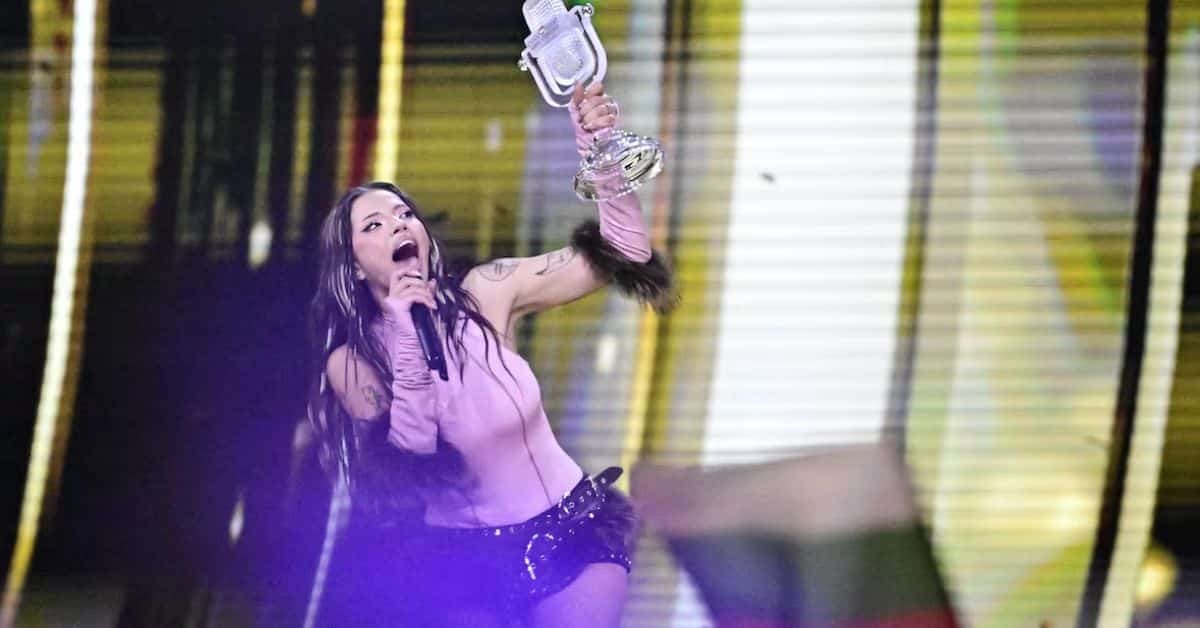

Bulgaria claimed its first-ever Eurovision victory on Saturday night as singer Dara won the 70th edition of the contest with her energetic party anthem Bangaranga. Competing against 24 other finalists in Vienna, Dara impressed both audiences and national juries with the song’s catchy rhythm and polished choreography.
Israel’s Noam Bettan finished in second place in a competition once again overshadowed by controversy surrounding Israel’s participation.
After a week of anticipation, performers from 25 countries took to the stage at Vienna’s Wiener Stadthalle arena, each hoping to secure Europe’s biggest pop music title. Millions of viewers watched a wide range of performances, from a fiery Finnish violin act and a Moldovan folk rapper to a Serbian metal band and many others. The flamboyant and colorful event is often compared to the World Cup — only with music instead of football.
As with major international sporting events, politics once again became part of the conversation. Eurovision faced renewed criticism over Israel’s involvement because of the ongoing conflict in Gaza and other regional tensions. Five longtime participants — Spain, the Netherlands, Ireland, Iceland, and Slovenia — chose to boycott this year’s competition in protest.
Despite the controversy, Eurovision continued its tradition of celebrating diverse musical styles. Over the decades, the contest has produced iconic hits such as Abba’s Waterloo and Nel blu, dipinto di blu — better known as Volare — along with countless Euro-pop anthems.
Each act had only three minutes to capture the attention of viewers and music-industry juries who together decide the winner. The show featured dramatic staging filled with flame effects, glitter cannons, and powerful wind machines, highlighting Europe’s wide-ranging musical tastes.
Serbia’s metal band Kravina delivered an intense hard rock performance, while Romania’s Alexandra Căpitănescu brought a darker edge with her provocatively titled song Choke Me. Albania’s Alis performed the emotional choral ballad Nan, dedicated to mothers.
Cyprus’ Antigoni energized the audience with the dance track Jalla. The United Kingdom’s novelty act Look Mum No Computer followed with the playful Eins, Zwei, Drei, before France’s Monroe impressed with the dramatic soprano performance Regarde!
Female solo performers dominated much of the competition, including Germany’s Sarah Engels with an uplifting power ballad, Poland’s Alicja with gospel-inspired R&B, Ukraine’s Leleka with an ethereal sound, and Sweden’s Felicia with techno-pop.
Male soloists also made a strong impression. Malta’s Aidan, Denmark’s Søren Torpegaard Lund, Norway’s Jonas Lovv, Italian crooner Sal Da Vinci, and Austria’s own Cosmo each brought distinct musical styles to the stage. Cosmo, representing the host nation, stood out with a retro-techno performance.
Australia’s Delta Goodrem delivered one of the night’s most theatrical moments with her ballad Eclipse, performing above a sparkling piano suspended in the air. Under Eurovision rules, if Australia were to win, a European country would likely host the contest on its behalf the following year.
Noam Bettan received loud applause during his performance of Michelle, a multilingual rock ballad sung in Hebrew, French, and English, though some boos could also be heard. Earlier in the week, four people were removed from the venue after attempting to interrupt his semifinal appearance.
Politics also appeared in some of the songs themselves. Moldova’s rapper Satoshi performed Viva, Moldova, described as a celebration of Europe from a nation increasingly moving closer to the European Union after years under Moscow’s influence. Greece’s Akylas used the song Ferto to humorously explore consumer culture in a country still affected by the scars of the 2008 financial crisis.
Eurovision winners are determined through a combined voting system involving both public viewers and professional juries. Points are awarded in a format that even longtime fans often find confusing. The country with the highest total earns the right to host the competition the following year.
Protests over Israel’s participation
Demonstrations against Israel’s inclusion were smaller in Vienna than in recent contests held in Malmö and Basel, though protests still took place throughout the week.
Before Saturday’s final, hundreds of demonstrators marched near the arena carrying signs reading “Block Eurovision.” On Friday, pro-Palestinian groups organized an outdoor concert under the slogan “No stage for genocide.”
“Inviting Israel on such a beautiful stage as the Eurovision Song Contest stage is an affront to all the people who believe in humanity, who believe in love and togetherness,” said Congolese-Austrian artist Patrick Bongola, one of the event organizers.
The boycott by five participating nations dealt a blow to the contest’s audience numbers and revenue. Organizers said last year’s event attracted 166 million viewers worldwide.
Even so, Eurovision continues to expand internationally. A new spinoff, Eurovision Song Contest Asia, is scheduled to take place in Bangkok this November. Eurovision director Martin Green encouraged viewers to set political tensions aside and focus on enjoying the “brilliant, wonderful, heartfelt show.”
Experts noted that political disputes are nothing new for Eurovision. The first boycott dates back to 1969, when Austria refused to participate in a contest hosted by Spain during the dictatorship of Francisco Franco.
“We’ve seen very politicized editions of the contest in the recent past,” Vuletic said. “All of them were very much mired in political controversy, yet Eurovision continues.”

Harnaik Singh Rathor is the Founder, Publisher, and Editor-in-Chief of StudioX News Canada, Canada's multilingual digital news network serving diaspora communities across 44 languages. With a background in media production, public relations, and multicultural communications, he founded StudioX Film and TV Corporation to bridge the gap between mainstream Canadian media and the country's diverse immigrant communities. He is a member of the Canadian Association of Journalists (CAJ), RTDNA Canada, CPRS Vancouver, NEPMCC, and the Canadian Freelance Union (Unifor). Based in Surrey, British Columbia. | LinkedIn: https://www.linkedin.com/in/harnaiksinghrathor/ | Muck Rack: https://muckrack.com/harnaiksinghrathor | Email: editor@studioxnews.ca