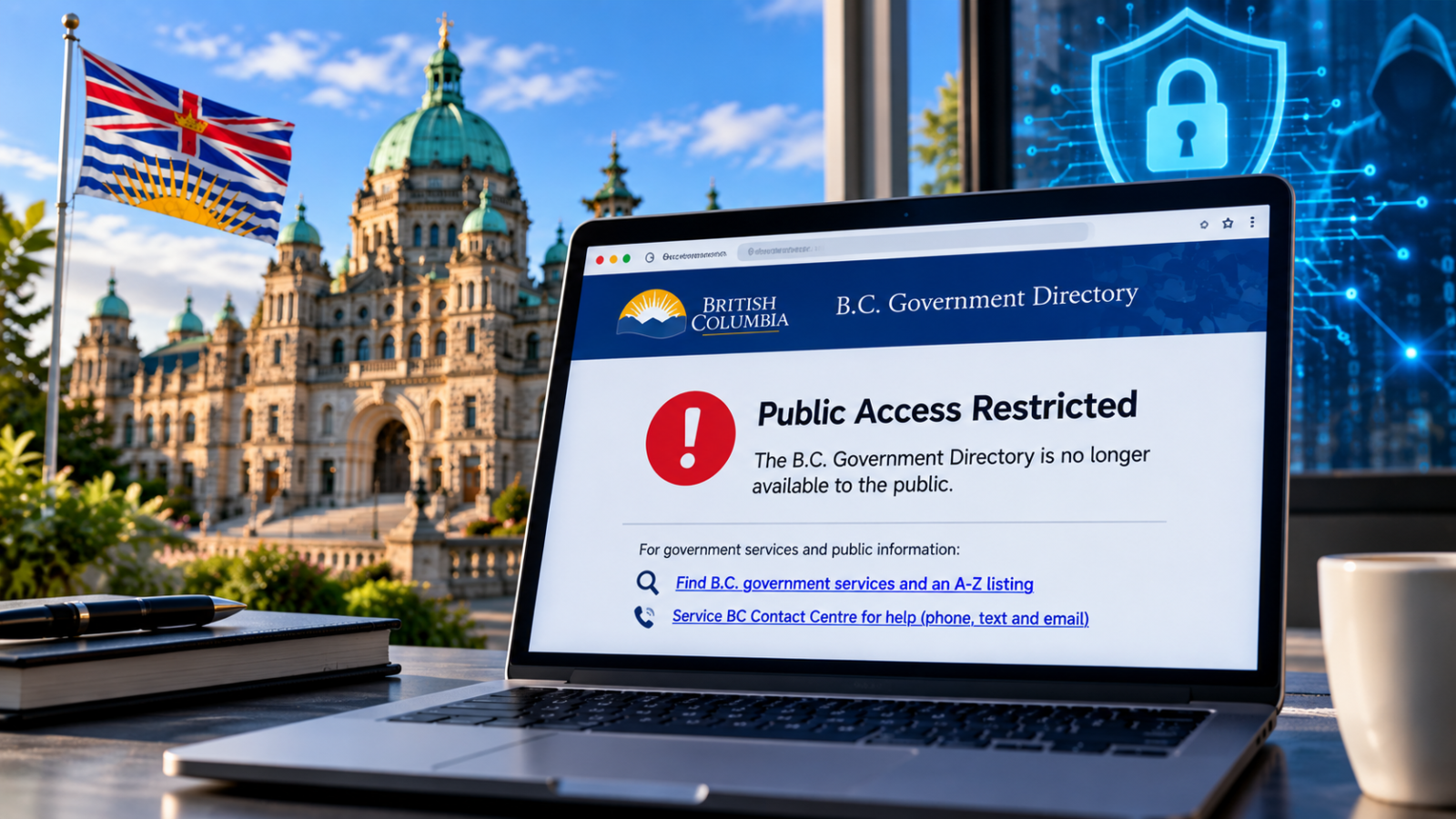

Province says AI is making it easier for cyber threat actors to harvest employee information and says RCMP and other law-enforcement partners advised the move. Critics and business groups are pushing for public access to be restored.
BRITISH COLUMBIA — British Columbia has pulled its public government employee directory offline, citing an increasingly hostile cybersecurity environment and the growing ability of artificial intelligence tools to help cyber threat actors harvest publicly available information and launch more convincing, targeted attacks.
The government directory went offline on Aug. 18, removing a longstanding public resource used by residents, businesses, community organizations, journalists and MLA offices to identify government employees and find the appropriate program or ministry contact.
The decision is now facing questions over transparency and public access, with critics and business organizations pushing for the directory — or an effective public replacement — to be restored.
At the same time, B.C.’s independent Information and Privacy Commissioner is evaluating the government’s decision.
Government says AI has changed the cybersecurity risk
In an exclusive statement provided on the record to StudioX News, the Ministry of Citizens’ Services said the directory was originally created to support legitimate public contact with government.
But the ministry said the same publicly available information can also be exploited by cyber threat actors.
“The directory was created to support legitimate contact with government, but the same information is available to anyone on the internet, including cyber threat actors,” the ministry said.
The province said it faces hundreds of cybersecurity attacks every day and that the threat has increased over the past several months.
“We fend off hundreds of cybersecurity attacks each day, and that risk has been increasing over the past few months as AI tools make it faster and easier to harvest public information and create more convincing, targeted messages and scripts,” the ministry said.
The government has not said that a specific cyberattack directly triggered the Aug. 18 decision.
Instead, its explanation focuses on the broader threat environment and the ability of increasingly sophisticated tools to turn publicly available information into targeted phishing, social-engineering and other cyber threats.
RCMP and law-enforcement partners advised government to act
The province says the decision also followed advice from law-enforcement partners.
“Given the increasing cyber threat environment, we received proactive advice from law enforcement partners, including the RCMP, to take this action,” the Ministry of Citizens’ Services told StudioX News.
The statement does not identify a specific RCMP investigation or threat associated with the directory.
The government’s position is that reducing the amount of individual employee information available publicly will make it harder for threat actors to gather the information they can use to target government employees.
Province promises a replacement
The government says it recognizes that the directory served an important purpose beyond providing individual contact information.
A public directory helped people understand how government was organized and determine which ministry, branch or program was responsible for a particular issue.
The province says it plans to provide an updated public directory.
“We will be providing an updated directory page soon, including senior executive contact information for all government ministries,” the ministry said.
The replacement will direct users toward ministry, service and media contacts while reducing the public exposure of individual employee contact information and associated cybersecurity risks.
However, the province has not provided a firm date for when the replacement will be launched.
It has also not provided a detailed interim system for residents, businesses, community organizations or MLA offices trying to locate specific program staff.
That has become one of the central concerns surrounding the shutdown.
Privacy Commissioner examining the decision
The controversy has also reached B.C.’s independent privacy watchdog.
On Aug. 25, the Office of the Information and Privacy Commissioner for B.C. confirmed that it was evaluating the government’s removal of public access to the directory.
The review is examining both the cybersecurity risks identified by government and the impact of the decision on transparency.
The OIPC’s involvement does not mean the Commissioner has determined that the government acted improperly.
Instead, the review puts the government’s decision under independent scrutiny at a time when B.C. is attempting to balance cybersecurity, employee privacy and the public’s ability to access government information.
As of Sept. 10, the Commissioner has not announced a final finding or recommendation specifically on the directory.
Critics push back on loss of public access
Criticism of the decision has focused on whether removing the entire public directory was necessary to address the cybersecurity concerns.
Members of the B.C. Conservative opposition have questioned the government’s approach, arguing that employee privacy and cybersecurity can be protected without eliminating meaningful public access to information about government.
Langley-Willowbrook MLA Jody Toor has raised concerns about the loss of a longstanding public resource and the effect of the decision on government transparency.
Richmond-Queensborough MLA Steve Kooner has also questioned the move, arguing that the government should be able to protect sensitive employee information while maintaining public access to government organizational information.
Former B.C. Conservative MLA Peter Milobar, now an independent MLA, has separately criticized the government’s rationale and argued that members of the public should continue to be able to identify and contact senior government officials.
The criticism does not necessarily dispute that cybersecurity threats exist.
Rather, opponents are questioning whether removing the directory entirely is a proportionate response and whether B.C. could have adopted a more limited approach — such as removing personal employee details while maintaining organizational information and appropriate government contacts.
Business groups seek restoration of directory access
The concerns extend beyond opposition politicians.
Records filed with B.C.’s Lobbyists Registry show business organizations have also raised the issue with the provincial government.
The Canadian Home Builders’ Association of B.C. reported lobbying senior government officials with the stated goal of restoring public access to the B.C. Government Directory.
Other organizations, including the Greater Vancouver Board of Trade, Canadian Fuels Association, Canadian Manufacturers & Exporters, Mining Association of British Columbia, Retail Council of Canada and Surrey Board of Trade, have also been involved in discussions concerning public access to the directory and efforts to restore access.
The lobbying activity illustrates the practical value the directory had for organizations that regularly interact with provincial ministries and government programs.
Why the directory matters
For many people, a government website’s general contact page is not enough.
Residents may know they have a problem but not which ministry or branch is responsible. Businesses may need to contact a specific regulatory or program area. Community organizations may need to identify the government office responsible for funding or services.
MLA offices also regularly need to navigate provincial ministries on behalf of constituents.
For newcomers unfamiliar with B.C.’s government structure, a searchable directory can provide an especially useful starting point for determining who is responsible for a particular program or issue.
Removing that resource can therefore create a practical barrier even when general government phone numbers and ministry websites remain available.
The central dispute: security versus transparency
The competing arguments are now clear.
The province says publicly available employee information has become a greater cybersecurity risk as threat actors gain access to increasingly powerful AI tools capable of rapidly collecting information and generating targeted communications.
Law-enforcement partners, including the RCMP, have advised government to take action, according to the Ministry of Citizens’ Services.
Critics, meanwhile, argue that government can protect individual employees without eliminating public access to the basic information people need to understand and navigate the provincial government.
Business groups have also sought restoration of public access, while the Privacy Commissioner is examining the government’s decision.
The province’s planned replacement directory could ultimately determine whether those competing concerns can be reconciled.
B.C. says the new system will include senior executive contact information for all ministries and direct users toward ministry, service and media contacts while reducing exposure of individual employees.
But until that replacement is launched, an important question remains unanswered: how will residents and organizations reach the right government program when they do not know who or where to contact?
The province has not provided a firm public launch date for the replacement.
For now, the Aug. 18 removal has left B.C. facing a debate that extends beyond cybersecurity — to the fundamental question of how much information a government should make publicly accessible in an era when the same information can be used both to connect citizens with government and to target government employees.
The government’s detailed explanation regarding the directory’s removal, cybersecurity concerns, AI-enabled targeting, law-enforcement advice and planned replacement was provided on the record exclusively to StudioX News by the Ministry of Citizens’ Services via Communications Manager Jennifer Fernandes.

Harnaik Singh Rathor is the Founder, Publisher, and Editor-in-Chief of StudioX News Canada, Canada's multilingual digital news network serving diaspora communities across 44 languages. With a background in media production, public relations, and multicultural communications, he founded StudioX Film and TV Corporation to bridge the gap between mainstream Canadian media and the country's diverse immigrant communities. He is a member of the Canadian Association of Journalists (CAJ), RTDNA Canada, CPRS Vancouver, Unifor, NEPMCC, and the Canada Freelance Union. Based in Surrey, British Columbia. | LinkedIn: https://www.linkedin.com/in/harnaiksinghrathor/ | Muck Rack: https://muckrack.com/harnaiksinghrathor | Email: editor@studioxnews.ca