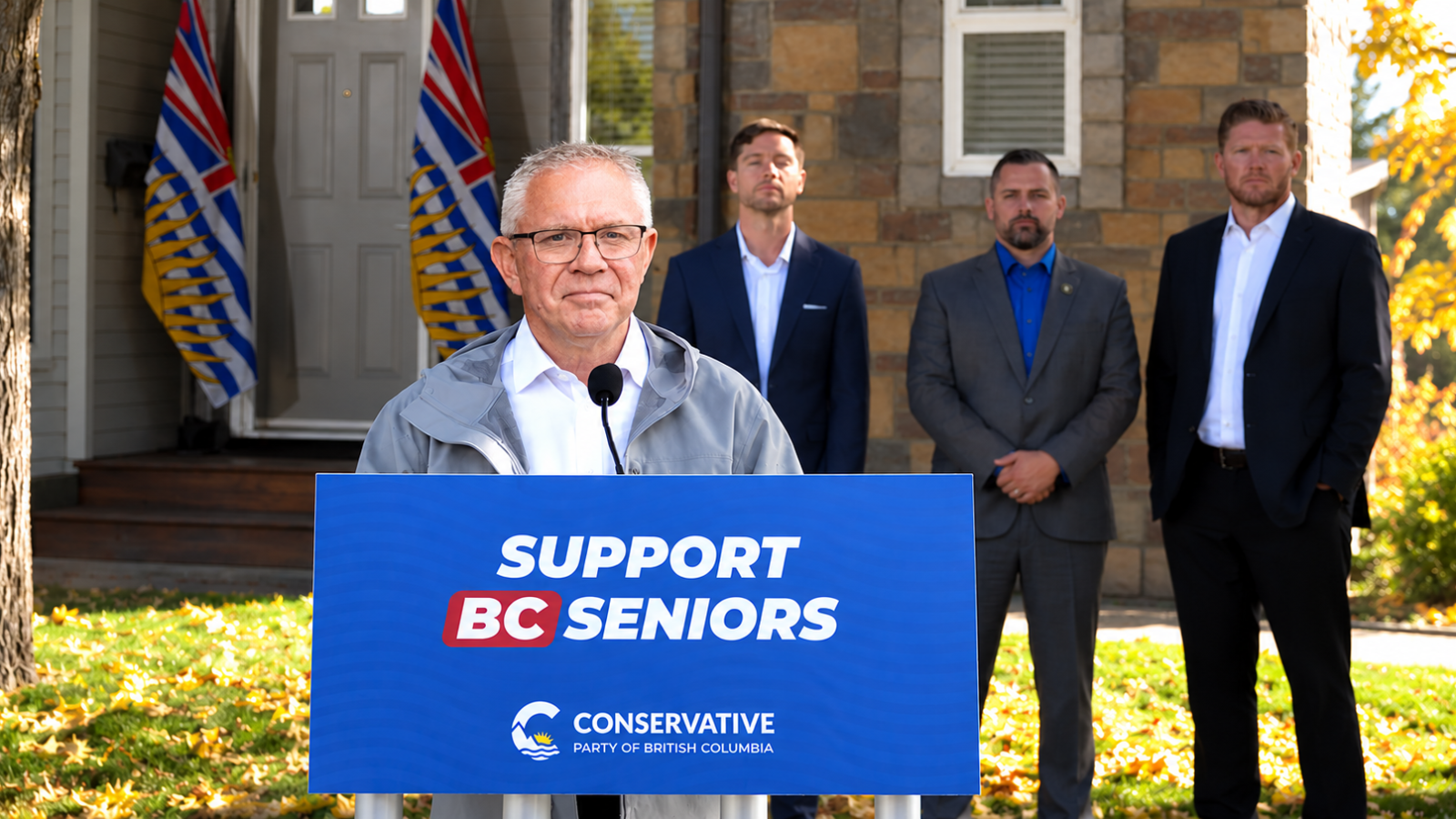

Doerkson outlines proposed changes to tax deferrals, long-term care and home support as B.C. government figures show rising demand for seniors’ services.
COQUITLAM, B.C. — Conservative Party of BC Leader Lorne Doerkson has announced a series of proposed measures aimed at reducing costs for older homeowners and expanding access to long-term care, home support and transportation for seniors.
The October 9 announcement brings together several campaign commitments, including reversing recent changes to the provincial Property Tax Deferment Program, building long-term-care beds more quickly and providing greater choice for seniors waiting for care.
The proposals come as B.C. faces growing demand for seniors’ services. The Office of the Seniors Advocate’s Monitoring Seniors Services 2025 report recorded 7,029 people waiting for a long-term-care bed in 2025, with average wait times increasing from 144 days to 287 days over six years.
Conservatives promise to reverse property-tax deferment changes
Under B.C.’s Property Tax Deferment Program, eligible homeowners can postpone paying property taxes, with the deferred amount and interest repaid later.
The provincial government changed the interest terms for taxes deferred from 2026 onward. The regular program now charges compound interest at prime plus two percentage points, compared with simple interest at prime minus two percentage points for taxes deferred in 2025 and earlier. Existing deferrals from those earlier years retain the previous terms.
Doerkson has promised to restore the previous terms if his party forms government.
The Conservatives say the changes increase costs for seniors who rely on the program to remain in their homes. Their campaign material cites an additional average cost of about $1,200 per year. That figure should be understood as the party’s estimate; the actual cost depends on the amount deferred, interest rates and the period before repayment.
In its May 2026 statement, B.C.’s Seniors Advocate, Dan Levitt, confirmed the change in interest terms and said the average amount deferred during the 2024/25 fiscal year was approximately $5,400. Levitt also encouraged eligible older homeowners facing financial pressure to consider the program despite the higher interest charges.
Seven long-term-care projects face adjusted timelines
The Conservatives have also pledged to speed up the construction of long-term-care facilities by reviewing design requirements they say have made some projects too expensive.
In Budget 2026, the B.C. government adjusted the delivery timelines for seven long-term-care projects in Abbotsford, Campbell River, Chilliwack, Delta, Fort St. John, Kelowna and Squamish.
The provincial government said the changes would allow it to review its long-term-care infrastructure program, manage construction costs and maintain safe, high-quality care. The budget documents describe the projects as having adjusted timelines; they do not simply characterize all seven as cancelled.
Doerkson says a Conservative government would work with care providers, residents, families and builders to review design requirements while maintaining safety and quality standards.
The party also proposes portable public funding for eligible seniors waiting for long-term care. Under the proposal, seniors and their families would be able to choose among qualified providers, including non-government facilities subject to performance safeguards.
The details of the proposed funding model, eligibility rules and safeguards would need to be established before the policy could be implemented.
Home care, transportation and other commitments
The broader seniors’ plan includes several additional proposals:
- Home care: Expand consumer-directed, publicly funded home-care options for seniors who want to remain in their homes.
- HandyDART: Expand service in areas with the greatest demand and enforce service-quality standards.
- Shingles vaccination: Provide free vaccination for seniors.
- Hearing aids: Offer financial assistance to seniors on low, fixed incomes.
- Protection from abuse and fraud: Strengthen support for vulnerable seniors and pursue tougher penalties for serious offences.
- Digital literacy: Expand education about online services, fraud and scams while maintaining access to government services for people who cannot or do not wish to use digital platforms.
- Public reporting: Advance a proposed Long Term Care Access and Transparency Act to publish monthly regional information on long-term-care waitlists, hospice capacity and home-support access.
These are campaign commitments, not measures that have already been implemented. The announcement does not provide a complete cost estimate, funding allocation or implementation timetable for the package.
Budget 2026 also changes the lowest income-tax rate
The Conservatives’ criticism also refers to the provincial income-tax change in Budget 2026.
The B.C. government increased the lowest personal income-tax rate from 5.06% to 5.60% for the 2026 tax year. The rate applies to the first $50,363 of taxable income. The government says the change represents an additional $76 in income tax for the average taxpayer in 2026, while more than 40% of taxpayers are expected to see savings when the increase in the B.C. tax reduction credit is included.
The change is relevant to seniors who pay provincial income tax, but its effect will vary depending on individual income and eligibility for tax credits. It does not mean every senior will pay more overall.
What happens next?
Doerkson’s announcement sets out the Conservative Party’s proposed approach to seniors’ housing costs, long-term care and support services. The proposals would require further policy development and, where applicable, government funding and implementation.
Key questions include how much the package would cost, how quickly additional care beds could be delivered, which seniors would qualify for portable funding, and how the proposed home-care and transportation expansions would be financed.
The announcement also leaves open how the party would measure progress and ensure that expanded access translates into shorter waits and more available services across the province.
For seniors and their families, the central issues remain the affordability of staying at home, access to appropriate care and the time required to receive support.
StudioX News will continue to examine the parties’ seniors’ policies, their proposed costs and their implications for older British Columbians.

Harnaik Singh Rathor is the Founder, Publisher, and Editor-in-Chief of StudioX News Canada, Canada's multilingual digital news network serving diaspora communities across 44 languages. With a background in media production, public relations, and multicultural communications, he founded StudioX Film and TV Corporation to bridge the gap between mainstream Canadian media and the country's diverse immigrant communities. He is a member of the Canadian Association of Journalists (CAJ), RTDNA Canada, CPRS Vancouver, NEPMCC, and the Canadian Freelance Union (Unifor). Based in Surrey, British Columbia. | LinkedIn: https://www.linkedin.com/in/harnaiksinghrathor/ | Muck Rack: https://muckrack.com/harnaiksinghrathor | Email: editor@studioxnews.ca