
VICTORIA, B.C. — A multi-front political battle has erupted across British Columbia and Ottawa following an economic impact assessment evaluating the domestic cost of the BC Ferries China contract and BC Ferries’ offshore procurement strategy.
The report, presented by economist Jim Stanford of the Centre for Future Work and commissioned by the 19-union Build Them Here Shipbuilding Coalition, determined that outsourcing four new major hybrid-electric vessels to China Merchants Industry (CMI Weihai Shipyard) forfeits $1.5 billion in Canadian GDP, 10,000 person-years of domestic employment, and $413 million in uncollected tax revenues that could have circulated within British Columbia.
Understanding the Implications of the BC Ferries China contract
The implications of the BC Ferries China contract extend beyond immediate costs, impacting long-term economic stability.
While the contract was initially framed by transit operators as a routine commercial acquisition, newly scrutinized financing agreements, legislative clashes, and parliamentary hearings reveal a fierce debate over public procurement, industrial sovereignty, and commuter transit reliability.
The Operational Driver: A Fleet Facing ‘Severe Risk of Failure’
Behind the political crossfire lies a critical infrastructure bottleneck: British Columbia’s marine highway is running on borrowed time.
According to BC Ferries’ technical filings and fleet aging models, the corporation faces an unavoidable retirement wall by 2029. While standard commercial ferries operate on an intended design life of 25 to 40 years, four of the province’s primary workhorses will have vastly exceeded safe operating thresholds before decade’s end:
- Queen of New Westminster: Scheduled to reach 65 years of age in 2029 (originally entered service in 1964).
- Queen of Alberni: Will reach 53 years of age in 2029 (entered service in 1976).
- Queen of Coquitlam: Will reach 53 years of age in 2029 (entered service in 1976).
- Queen of Cowichan: Will reach 53 years of age in 2029 (entered service in 1976).
(See infographic below: “Age of Major Route Vessels in 2029”)
Internal fleet data categorizes vessels over 50 years old as operating under a “severe risk of failure.” In 2024 alone, over 250,000 passengers experienced delays or cancellations—largely tied to mechanical breakdowns on these aging hulls. Concurrently, peak summer sailings operated at 92 percent capacity, with reservations selling out days in advance. While provincial forecasts project B.C.’s population to increase by 44 percent by 2046, vehicle deck capacity on major coastal routes has remained flat for nearly 30 years.
What Is Actually Being Built: The Summit Class
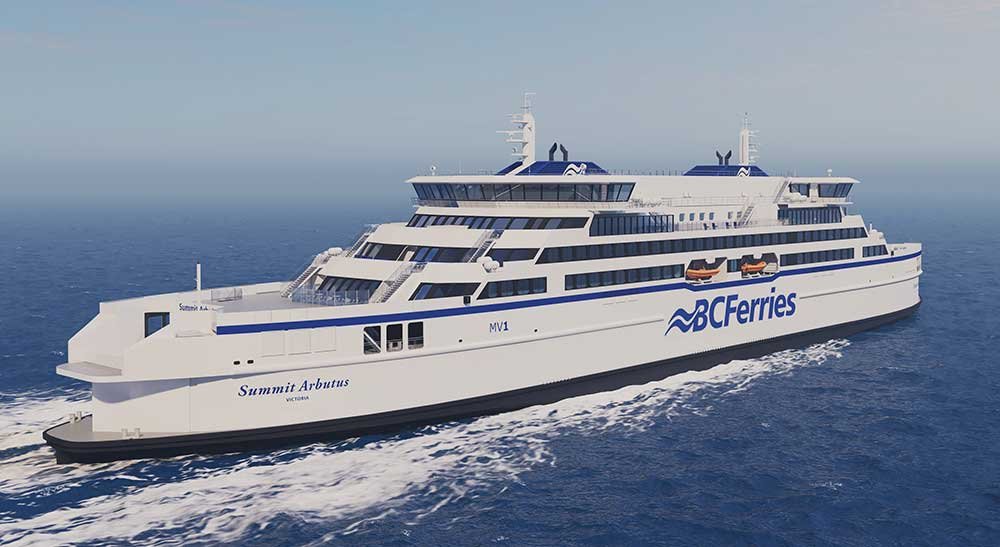
To resolve the capacity crisis, BC Ferries contracted Norwegian naval architecture firm LMG Marin AS to design the Summit Class—the largest capital vessel procurement in provincial history. The initial four newbuilds (Summit Arbutus, Summit Cedar, Summit Maple, and Summit Spruce) will be deployed directly across the busiest economic arteries connecting Metro Vancouver and Vancouver Island:
- Route 1: Tsawwassen – Swartz Bay
- Route 2: Horseshoe Bay – Departure Bay
- Route 30: Tsawwassen – Duke Point
Each double-ended Summit-class vessel will carry 360 standard vehicles and up to 2,100 passengers and crew—delivering an immediate 24 percent boost in vehicle capacity (+80 vehicles) and a 52 percent surge in passenger capacity (+1,000 passengers) per sailing compared to the ships they replace.
The ships feature hybrid-propulsion systems engineered for conversion to 100 percent zero-emission battery electric propulsion once terminal high-voltage shore power is built, low-frequency underwater propellers designed to reduce acoustic interference for Southern Resident killer whales, interior passenger pet lounges, and two-level vehicle decks designed for rapid turnaround times. Deliveries are scheduled to commence in spring 2029 and run through 2031.
The Federal Connection: $1B CIB Loan Sparks Ottawa Inquiries
The controversy widened beyond Victoria into the House of Commons after it was confirmed that the Canada Infrastructure Bank (CIB)—a federal Crown corporation—authorized a $1 billion loan facility to BC Ferries.
Of that total facility, up to $690 million was allocated to finance the acquisition of the four Chinese-built vessels, while roughly $310 million was earmarked for terminal electrification.
The use of federal credit to finance offshore fabrication provoked swift condemnation across party lines in Ottawa:
- Federal Disapproval: Federal cabinet ministers distanced themselves from the decision. Former Deputy Prime Minister Chrystia Freeland told members of Parliament she was “dismayed that BC Ferries would select a Chinese state-owned shipyard to build new ferries in the current geopolitical context.”
- Parliamentary Hearings: The House of Commons Standing Committee on Transport, Infrastructure and Communities summoned BC Ferries CEO Nicolas Jimenez and federal officials to testify, interrogating why Canadian public financing mechanisms were tapped to underwrite foreign state-owned manufacturing while domestic shipyards were bypassed.
The Critics: B.C. Conservatives, Unions, and Shipbuilders Align
Inside British Columbia, opposition lawmakers and trade unions argue Victoria displayed an abject failure of industrial planning:
- Harman Bhangu (B.C. Conservative Transportation Critic & MLA for Langley-Abbotsford): Confronted Transportation Minister Mike Farnworth during legislative estimates, arguing the province abandoned domestic trades:“The government talks about supporting B.C. jobs, then quietly sends them overseas to a state-owned shipyard in China. Is this the right time to be giving all your money to China… or is it time to take this seriously and create some good-paying jobs?”Bhangu argued that Victoria should have implemented a phased procurement strategy—contracting the first vessel to meet the 2029 deadline while committing the remaining three hulls to domestic shipbuilders like North Vancouver’s Seaspan to justify expanding local drydock capacity.
- John Rustad (B.C. Conservative Leader): Challenged the government on national security and international trade grounds:“You don’t turn around and reward them with a contract for a billion dollars when they are intentionally damaging our economy,” Rustad stated, citing ongoing punitive trade actions by Beijing targeting Canadian agricultural exports.
- The Union Coalition (Build Them Here): The 19-union alliance underscored that between 2003 and 2024, only two of 21 new vessels added to the BC Ferries fleet were built in B.C. Economist Jim Stanford called the absence of Canadian tenders an institutional cop-out:“It is incomprehensible that a major publicly funded purchase like this would simply be hived off to China because it’s easier and possibly cheaper… Government planners knew a decade ago these ships would reach end of life.”
- Domestic Industry (Davie Shipyard): Quebec shipbuilder Davie pointed out that private Canadian yards cannot compete on sticker price against foreign state enterprises that benefit from direct government subsidies, subsidized domestic steel, and lower labor overhead.
The BC NDP & BC Ferries Counter-Defense: Cost Barriers and Commuter Fares
The governing BC NDP and BC Ferries leadership counter that practical realities and commuter economics left them with no domestic option.
- Zero Canadian Bids: BC Ferries verified that while two Canadian shipbuilders pre-qualified during the five-year Request for Proposals (RFP), neither submitted a binding commercial bid. Domestic yards, including Seaspan, were already booked with combat and non-combat vessels under Ottawa’s National Shipbuilding Strategy (NSS) and lacked the available drydock berths or workforce capacity to meet the 2029 delivery window.
- Premier David Eby: Stood firm against demands to tear up or renegotiate the contract, warning that restarting procurement would cause transit and economic chaos:“The decision to reopen a five-year procurement process… is not just a billion-dollar decision. It’s well in excess of that, when you are retendering again in an inflationary environment, in addition to the time it would take.”“It’s equally vital to me, that when there is no Canadian company willing to bid on a contract, that we don’t leave families sitting on the tarmac, waiting for a ferry because the propeller fell off, because it’s 50 years old.”
- The $1.2B Farepayer Shield: BC Ferries disclosed that bids from Western European yards came in $1.2 billion higher than the winning Chinese tender. Under the Coastal Ferry Act, capital cost escalations flow directly into the fare-setting formula overseen by the independent B.C. Ferry Commissioner. Procuring from higher-cost foreign yards or subsidizing local drydock construction would have driven up fares by double digits for coastal residents and freight haulers.
- Guaranteed Domestic Maintenance: Provincial officials emphasized that hull fabrication represents only the initial phase of a vessel’s lifecycle. BC Ferries already injects over $130 million annually into B.C. shipyards for fleet servicing. For these four vessels alone, local drydocks are projected to secure $240 million over their first decade and over $1 billion in refits and maintenance across their 45-year lifespan.
Key Comparisons
| Policy Dimension | Critics & Labour Coalition | BC NDP & BC Ferries |
| Primary Goal | Rebuild domestic industrial capability and local trades jobs. | Safeguard commuter fares, system reliability, and capacity. |
| Economic Benchmark | Recapture $1.5B in GDP, 10,000 person-years of work, and $413M in taxes. | Avoid an estimated $1.2B in additional capital debt and fare spikes. |
| Procurement Result | Rules reward state-subsidized foreign yards on sticker price. | Two Canadian yards pre-qualified, but neither submitted a final commercial bid. |
| Federal Financing | Federal Crown bank (CIB) loans underwrite foreign shipyard fabrication. | CIB low-interest credit protects overall capital debt from skyrocketing. |
| Fleet Realities | Stagger timelines to allow local yards to expand drydock facilities. | Four vessels exceed 50 years old; 250,000 riders delayed in 2024 alone. |
| Local Industry Share | Misses a generational anchor opportunity to train new Canadian shipwrights. | Retains over $1B in lifetime maintenance and refits inside B.C. drydocks. |
The Choice Facing British Columbians
The Summit-Class dispute highlights a core governance trade-off:
Should British Columbia treat public transit investments as an instrument of industrial policy—absorbing higher fares, public debt, and construction delays to rebuild domestic heavy manufacturing?
Or should BC Ferries prioritize reliability and cost containment—purchasing capacity on the global market to protect daily commuters and keep coastal supply chains moving?

Harnaik Singh Rathor is the Founder, Publisher, and Editor-in-Chief of StudioX News Canada, Canada's multilingual digital news network serving diaspora communities across 44 languages. With a background in media production, public relations, and multicultural communications, he founded StudioX Film and TV Corporation to bridge the gap between mainstream Canadian media and the country's diverse immigrant communities. He is a member of the Canadian Association of Journalists (CAJ), RTDNA Canada, CPRS Vancouver, Unifor, NEPMCC, and the Canada Freelance Union. Based in Surrey, British Columbia. | LinkedIn: https://www.linkedin.com/in/harnaiksinghrathor/ | Muck Rack: https://muckrack.com/harnaiksinghrathor | Email: editor@studioxnews.ca