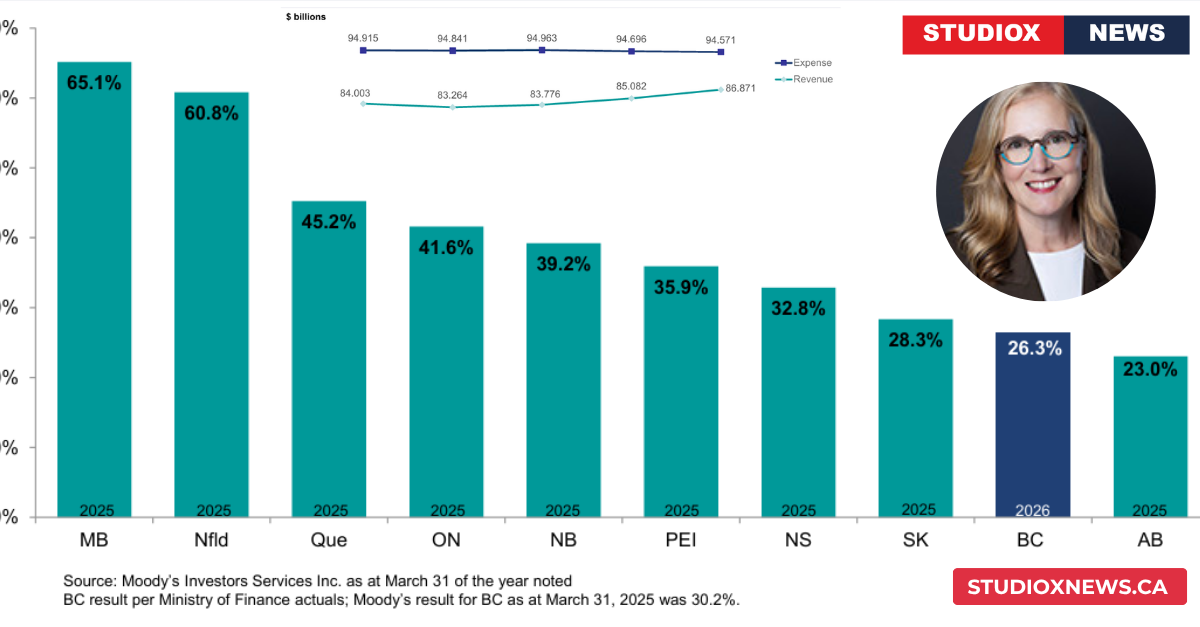

The Province’s final books for the year ending March 31, 2026 land $3.2 billion better than the Budget 2025 projection, helped by a large tobacco settlement, higher ICBC earnings and spending restraint.
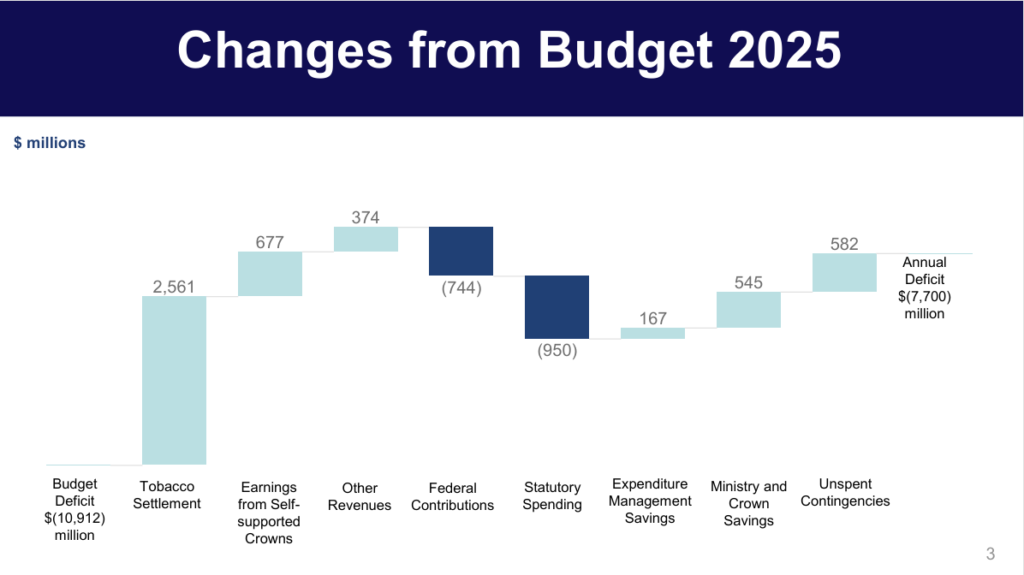
British Columbia recorded a $7.7 billion deficit for the 2025-26 fiscal year, coming in $3.2 billion lower than the $10.9 billion shortfall forecast in Budget 2025, according to the Province’s Public Accounts released Monday in Victoria.
Finance Minister Brenda Bailey and Comptroller General Nicole Wright presented the audited consolidated financial statements for the year ending March 31, 2026, at the Parliament Buildings press theatre.
“We released Budget 2025 during a time of incredible uncertainty, on the first day that the U.S. imposed sweeping tariffs on many Canadian goods,” Bailey said. “We responded by protecting investments in front-line services and programs that save people money, and by expediting the major projects we need to create jobs and economic growth.”
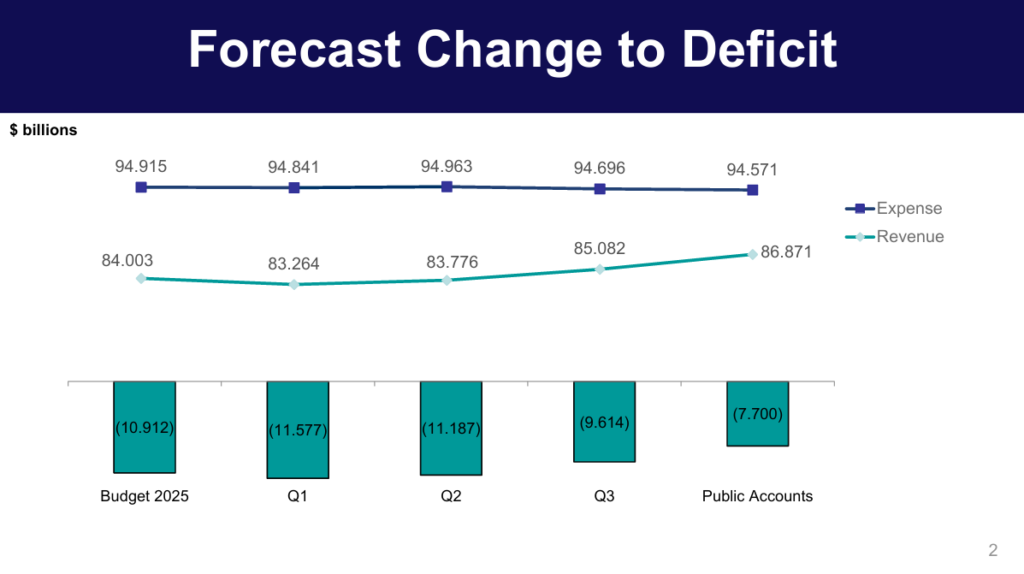
Total revenue for the year reached $86.9 billion, roughly $2.9 billion higher than budgeted. Expenses held at $94.6 billion, about $344 million below the Budget 2025 projection. The deficit narrowed steadily through the year, moving from the $11.6 billion projected at the first quarter to $9.6 billion by the third quarter before finishing at $7.7 billion.
The biggest single driver of the improvement was a $2.6 billion tobacco litigation settlement, along with higher net income at ICBC. Higher earnings from self-supported Crown corporations added $677 million, and other revenues contributed $374 million. On the spending side, the Province exceeded its own expenditure-management target, banking $467 million in savings against a $300 million goal through reduced discretionary spending, voluntary retirements and hiring restrictions.
Those gains were partly offset by a $744 million drop in federal contributions and $950 million in higher statutory spending.
The economy behind the numbers
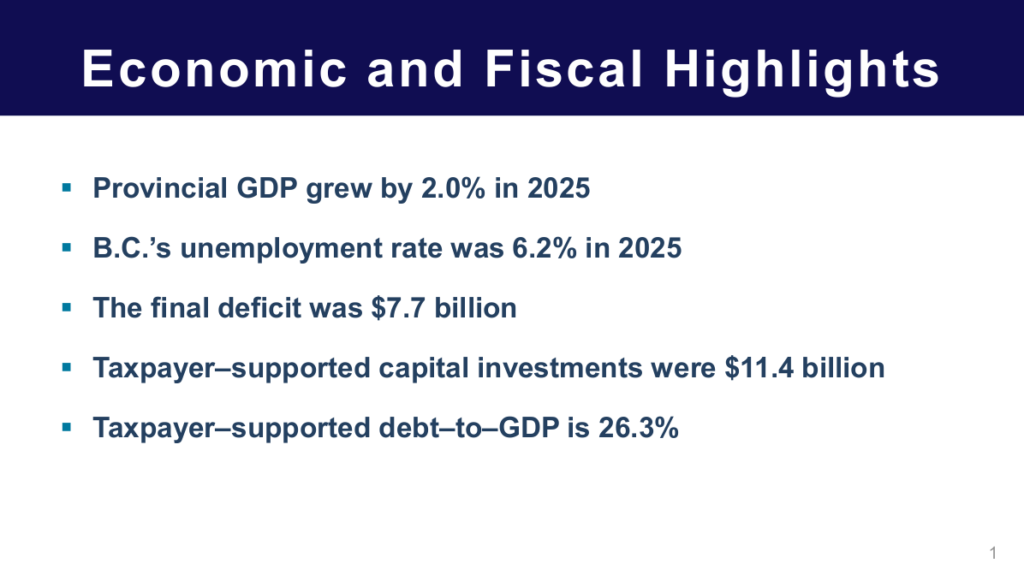
Provincial GDP grew 2.0 percent in 2025, above the 1.8 percent forecast in Budget 2025. Employment rose 1.1 percent, also ahead of forecast, and B.C.’s unemployment rate averaged 6.2 percent over the year, below the national average.
Infrastructure spending
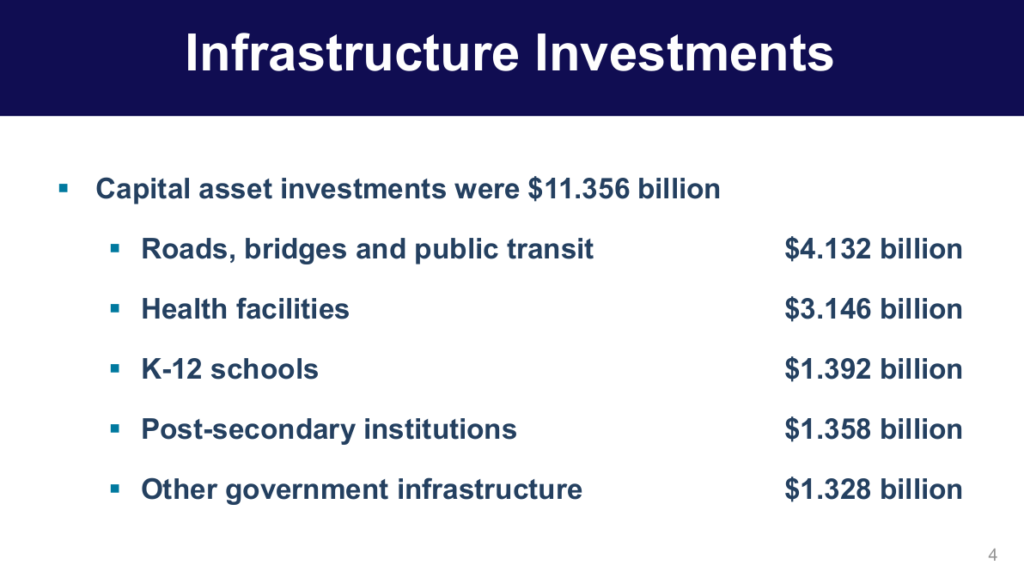
Capital asset investments totalled $11.4 billion for the year, about $1 billion more than the previous year. The largest share, $4.1 billion, went to roads, bridges and public transit. Health facilities drew $3.1 billion, while K-12 schools and post-secondary institutions together accounted for roughly $2.8 billion. A further $1.3 billion went to other government infrastructure.
Debt picture
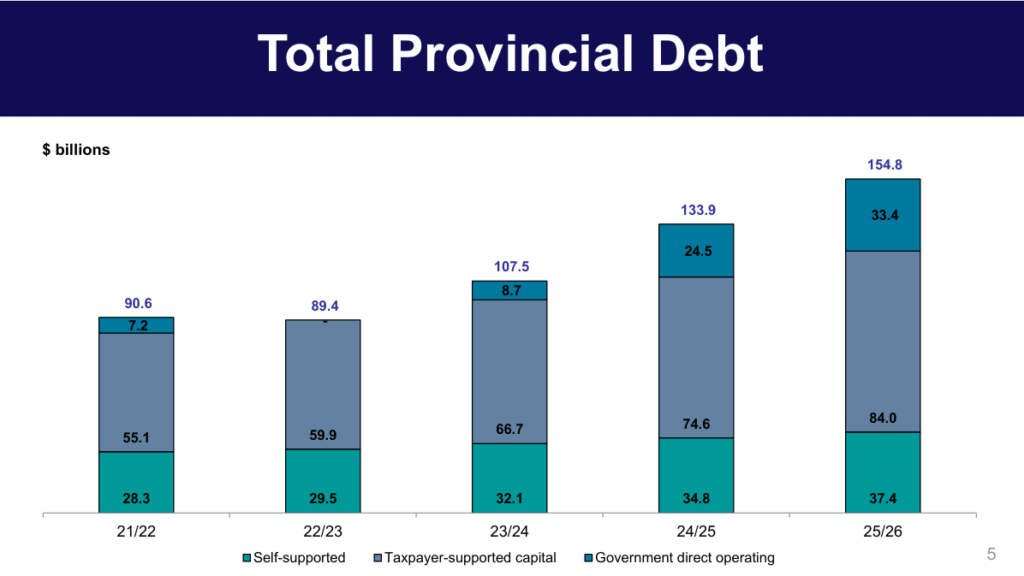
Total provincial debt rose to $154.8 billion, up from $133.9 billion a year earlier. That figure breaks down into $37.4 billion in self-supported debt, $84.0 billion in taxpayer-supported capital debt, and $33.4 billion in government direct operating debt. Taxpayer-supported debt increased by $18.4 billion over the year.
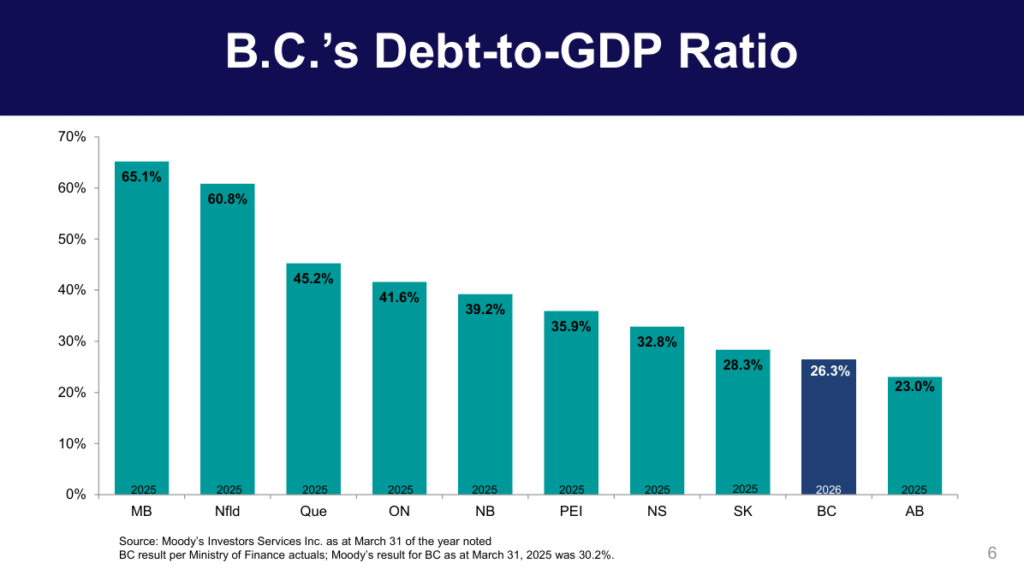
Even with the increase, B.C.’s taxpayer-supported debt-to-GDP ratio sits at 26.3 percent, the second lowest of any province in Canada after Alberta at 23.0 percent. Manitoba and Newfoundland and Labrador sit highest, at 65.1 percent and 60.8 percent.
Economic plan
Alongside the results, the Province pointed to its Look West action plan, which identifies 35 major projects, including LNG facilities, mines and BC Hydro clean-energy projects, with eight approved and under construction. B.C. also marked the first shipments of LNG from LNG Canada in Kitimat to Asia during the year.
“We have ambitious goals for B.C.‘s future,” Bailey said. “We’re developing major resource projects responsibly and building the hospitals, roads and schools British Columbians need.”
What comes next
The Province’s first quarterly report for 2026-27 is due in September, with the budget process for 2027-28 beginning this fall. A second quarterly report follows in November, the Economic Forecast Council meets in December, and Budget 2027 is scheduled for February.

Harnaik Singh Rathor is the Founder, Publisher, and Editor-in-Chief of StudioX News Canada, Canada's multilingual digital news network serving diaspora communities across 44 languages. With a background in media production, public relations, and multicultural communications, he founded StudioX Film and TV Corporation to bridge the gap between mainstream Canadian media and the country's diverse immigrant communities. He is a member of the Canadian Association of Journalists (CAJ), RTDNA Canada, CPRS Vancouver, NEPMCC, and the Canadian Freelance Union (Unifor). Based in Surrey, British Columbia. | LinkedIn: https://www.linkedin.com/in/harnaiksinghrathor/ | Muck Rack: https://muckrack.com/harnaiksinghrathor | Email: editor@studioxnews.ca