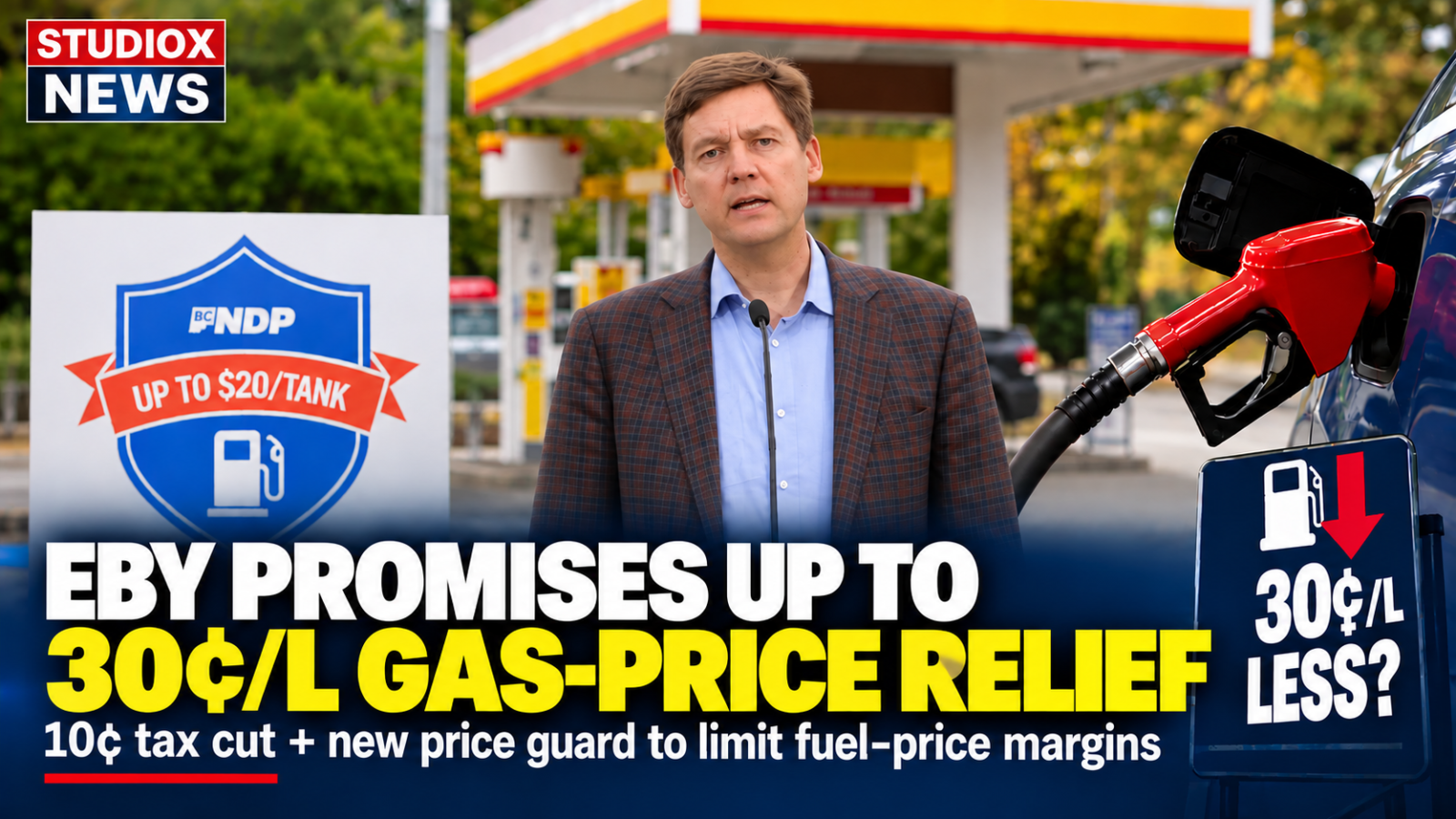
SURREY, B.C. — BC NDP Leader David Eby is promising temporary relief at the gas pump if his party is re-elected, proposing a 10-cent-per-litre reduction in the provincial motor-fuel tax and new regulatory powers aimed at limiting fuel-price margins.
The NDP says the two measures could provide drivers with up to 30 cents per litre in savings, including as much as $20 on a full tank.
Eby announced the plan Thursday in Surrey, saying the measures are intended to respond to elevated gasoline and diesel prices and provide relief to families, commuters and truck drivers.
The proposal has two parts.
First, the NDP says it would temporarily reduce the provincial motor-fuel tax by 10 cents per litre on both gasoline and diesel.
Second, the party is proposing a new “price guard” system that would give the B.C. Utilities Commission authority to establish maximum retail prices for gasoline and diesel.
Under the proposal, the maximum price would be adjusted according to benchmark crude-oil prices and other costs, including refining, transportation, taxes and retailer margins. The NDP says prices could be adjusted more frequently during major market disruptions or supply interruptions.
How much could drivers save?
The NDP says a driver of a mid-size SUV or minivan with a 68-litre tank could save up to $20 per fill-up, while a compact-car driver could save up to $15.
The party estimates that a typical two-car family in Surrey could save approximately $100 per month.
For truck drivers, the NDP says a short-haul or regional truck with a 400-litre diesel tank could save as much as $116 per fill-up, while long-haul operators could see larger potential savings.
The figures are estimates from the NDP’s campaign proposal and are described as savings of “up to” the stated amounts.
Eby says tax relief could come quickly
During the media question period following the announcement, Eby was asked when drivers could expect to see the proposed reduction.
He said the 10-cent fuel-tax reduction would be temporary and could be implemented without new legislation.
“If elected,” Eby said, the government could issue an order and implement the reduction “as soon as we can.”
The proposed price guard would follow a different process.
Eby said legislation would be required to give the B.C. Utilities Commission the additional authority to regulate fuel prices and margins. He said the government would introduce that legislation “right away.”
That means the two parts of the proposal would have different implementation requirements: the temporary tax reduction could be ordered directly, while the broader price-regulation system would require legislative approval.
Eby points to fuel-company margins
Eby defended the proposed price guard by pointing to recent monitoring of gasoline and diesel prices by the B.C. Utilities Commission.
The NDP’s backgrounder says gasoline prices increased by an average of 36 cents per litre following the start of the conflict involving the United States and Iran.
The party says approximately 22 cents of that increase was attributable to higher crude-oil costs, while industry margins increased by about 20 cents per litre.
Eby argued that the issue was not simply the global price of oil, but also what happens between the cost of crude and the final price paid by consumers.
He said the proposed regulatory system would allow the province to establish clearer rules around industry costs and margins.
The NDP also claims that British Columbians incurred an estimated $865 million in additional fuel costs because of increased margins during the period examined in its backgrounder.
That $865-million figure is an estimate presented by the NDP based on its interpretation of the underlying pricing data and should be understood as a campaign claim rather than an independently established amount.
Eby questioned about a previous election promise
The announcement also prompted questions about whether voters can expect the new commitment to be delivered if the NDP wins another term.
Eby was asked about the party’s previous promise of up to a $1,000 grocery rebate, which was ultimately not implemented.
Eby acknowledged that the government changed course, saying circumstances had changed and that the government instead eliminated B.C.’s consumer carbon tax.
He argued that the resulting tax relief was partly offset by increased charges elsewhere in the fuel market.
Eby said the new proposal is intended to provide more stability, predictability and transparency for consumers.
A difference in the announced cost
The cost of the proposed 10-cent-per-litre fuel-tax reduction also produced two different figures during the event.
The written NDP backgrounder provided to media says the measure would cost approximately $280 million through April 2027.
During the question period, however, Eby referred to the cost as approximately $250 million.
When asked about the broader cost of the commitments, Eby said the full costing would be provided to British Columbians during the campaign.
The difference between the two figures is therefore an outstanding point requiring clarification from the BC NDP.
What happens to transportation funding?
The NDP’s backgrounder says most of B.C.’s motor-fuel tax revenue supports public transit, including TransLink and BC Transit, as well as roads and highways through the B.C. Transportation Financing Authority.
The proposal says those transportation funding streams would be maintained while the temporary reduction is introduced.
The party says the reduction would instead affect the portion of fuel-tax revenue going to general government revenue.
A proposal that would require legislation
The proposed price guard represents a larger policy change than the temporary tax reduction.
Under the NDP’s proposal, the B.C. Utilities Commission would determine maximum retail prices using a formula based on benchmark crude prices and other costs.
The regulator would also determine allocations for refining and retailer margins, including what the proposal describes as a reasonable rate of return.
The maximum price could vary between regions to account for differences in transportation, storage, operating costs and taxes.
The NDP says the system would also contain provisions allowing prices to be changed more frequently when sudden international market disruptions or supply-chain interruptions occur.
Election promise, not yet implemented
The measures announced Thursday remain election commitments.
B.C.’s 2026 provincial election is scheduled for October 24, with candidate nominations closing October 3.
For drivers, the central question now is how quickly the proposed 10-cent tax reduction could appear at the pump and whether the proposed price guard would ultimately deliver the additional savings claimed by the NDP.
The party is promising up to 30 cents per litre in combined relief.
Whether drivers actually see that full amount will depend on the implementation of both measures, future fuel-market conditions and the regulatory framework proposed by the NDP.

Harnaik Singh Rathor is the Founder, Publisher, and Editor-in-Chief of StudioX News Canada, Canada's multilingual digital news network serving diaspora communities across 44 languages. With a background in media production, public relations, and multicultural communications, he founded StudioX Film and TV Corporation to bridge the gap between mainstream Canadian media and the country's diverse immigrant communities. He is a member of the Canadian Association of Journalists (CAJ), RTDNA Canada, CPRS Vancouver, NEPMCC, and the Canadian Freelance Union (Unifor). Based in Surrey, British Columbia. | LinkedIn: https://www.linkedin.com/in/harnaiksinghrathor/ | Muck Rack: https://muckrack.com/harnaiksinghrathor | Email: editor@studioxnews.ca