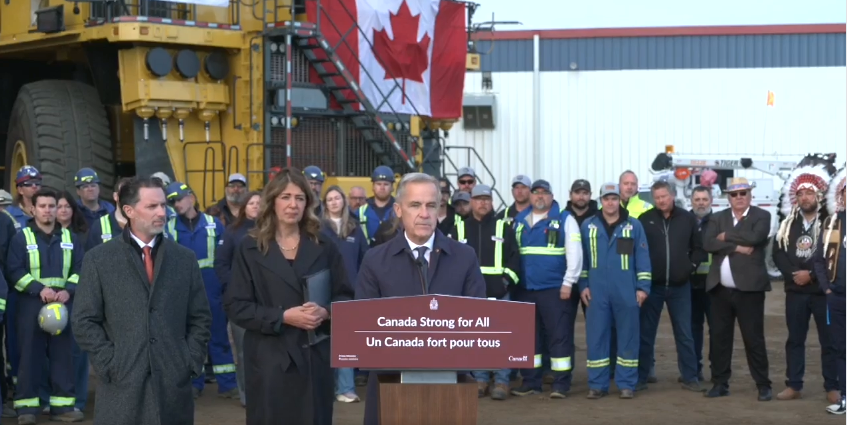

October 1, 2026 | Fort McMurray, Alberta
Prime Minister Mark Carney has officially designated the proposed Pacific Link oil pipeline as a project of national interest, moving the planned Alberta-to-British Columbia export route into the next stage of federal review.
Carney made the announcement Thursday in Fort McMurray alongside Alberta Premier Danielle Smith, industry representatives and Indigenous leaders.
The pipeline, previously referred to as the West Coast Oil Pipeline, is proposed to transport an additional one million barrels of oil per day to Canada’s West Coast, providing access to international markets in Asia.
Carney said the federal government had consulted with more than 130 Indigenous communities near or along potential routes in Alberta and British Columbia over the past three months, while receiving more than 100 submissions from Indigenous rights holders.
Designation is not final construction approval
The announcement represents a significant regulatory step, but it does not mean construction begins immediately.
During a question-and-answer session, Carney was asked directly how the national-interest designation compares with final project approval.
He said the next approximately 11 months will involve developing the conditions for the project, including engineering estimates, final cost estimates, equipment planning and environmental processes.
Those conditions are targeted for completion by September 1, 2027. Carney said the eventual decision to proceed will depend on those conditions as well as economic and other considerations.
The federal government says the Major Projects Office, supported by the Canada Energy Regulator, will lead the process.
The work will include consultations on ownership, benefits, environmental protections, local hiring, contracting and oversight.
Canada and Alberta to share ownership
Under the current arrangement, Canada and Alberta would hold equal ownership in Pacific Link.
Indigenous communities will be offered a minimum 10 per cent ownership interest, financed through federal and Alberta Indigenous Loan Guarantee Programs.
Carney said the project will also include Indigenous contracting and employment opportunities.
Trans Mountain Corporation will lead project development, while Pembina Pipeline Corporation is participating as a private-sector investor.
Pembina CEO Scott Burrows said the company plans to bring its experience in developing and operating energy infrastructure to the project.
Proposed route would avoid B.C.’s North Coast
The proposed pipeline would use a southern route intended to avoid B.C.’s North Coast and sensitive ecosystems, including the Great Bear Sea.
The project is also being developed alongside planned expansion of marine infrastructure and additional conservation measures.
Carney said the federal government is investing $10 billion to expand Roberts Bank Terminal, which he described as the planned landing point for crude transported through Pacific Link.
The federal government has also linked Pacific Link with the Pathways Alliance carbon capture and storage project, saying emissions-reduction technology will be important to the long-term competitiveness of Alberta oil.
One million barrels per day and projected economic benefits
Carney said about 90 per cent of Alberta’s oil currently goes to the United States, arguing that Pacific Link would provide additional market options by enabling up to one million barrels per day of additional exports to Asian markets.
The federal government estimates Pacific Link could create approximately 140,000 jobs across Canada, generate more than $20 billion in GDP annually, and produce more than $100 billion in government revenue by 2060.
Those figures are government estimates associated with the proposed project.
During the news conference, Carney also said the companies that would need to make additional upstream investments have not provided a government guarantee to proceed. He characterized those investment decisions as commercial decisions for the companies involved.
Alberta calls it a major step forward
Premier Danielle Smith described the designation as an important milestone for Alberta’s energy sector.
Smith said Alberta had submitted the West Coast pipeline proposal to the Major Projects Office in July and had subsequently announced partnerships involving the federal government, Trans Mountain and Pembina.
She said the goal is to secure the necessary approvals and conditions so that design and construction could begin as early as September 1, 2027.
Smith also pointed to potential infrastructure requirements around Fort McMurray, including transportation, housing, schools, health care and other community services if activity increases in the region.
During the news conference, she said there are approximately 40,000 service lots that could be developed if supporting infrastructure projects move ahead, including improvements to Highway 881.
Fort McMurray positioned for potential growth
Carney said the project could bring sustained economic growth to the Fort McMurray region rather than another short-term boom.
Asked whether Pacific Link could trigger another boom similar to previous periods of rapid growth in Fort McMurray, Carney said he would describe the opportunity as “sustained growth.”
He pointed to infrastructure planning, Indigenous participation and technological innovation as factors that could broaden the economic benefits of the project.
The prime minister also argued that the pipeline is part of a broader federal strategy to diversify Canada’s exports, increase non-U.S. trade and expand investment in the Canadian economy.
For now, Pacific Link remains a proposed project moving through a new federal review framework.
The next major milestone is the development of the project’s conditions document, targeted for September 1, 2027. Construction could begin after that point if the required conditions, approvals and economic decisions are satisfied.

Harnaik Singh Rathor is the Founder, Publisher, and Editor-in-Chief of StudioX News Canada, Canada's multilingual digital news network serving diaspora communities across 44 languages. With a background in media production, public relations, and multicultural communications, he founded StudioX Film and TV Corporation to bridge the gap between mainstream Canadian media and the country's diverse immigrant communities. He is a member of the Canadian Association of Journalists (CAJ), RTDNA Canada, CPRS Vancouver, NEPMCC, and the Canadian Freelance Union (Unifor). Based in Surrey, British Columbia. | LinkedIn: https://www.linkedin.com/in/harnaiksinghrathor/ | Muck Rack: https://muckrack.com/harnaiksinghrathor | Email: editor@studioxnews.ca