
British Columbia has secured a landmark federal-provincial agreement worth multiple billions of dollars, positioning the province as Canada’s economic engine while protecting environmental commitments that have shaped regional debate for decades.
The Canada-British Columbia Cooperative Prosperity Agreement, announced July 2 by Premier David Eby and Prime Minister Mark Carney, directs up to $3 billion toward the Fraser River Tunnel Project—a critical transportation corridor for Metro Vancouver—while committing federal support to the Red Chris mine expansion and the North Coast Transmission Line (NCTL). The NCTL investment alone delivers an estimated $3.9 billion net benefit to B.C. ratepayers, addressing long-standing infrastructure gaps that have constrained regional development.
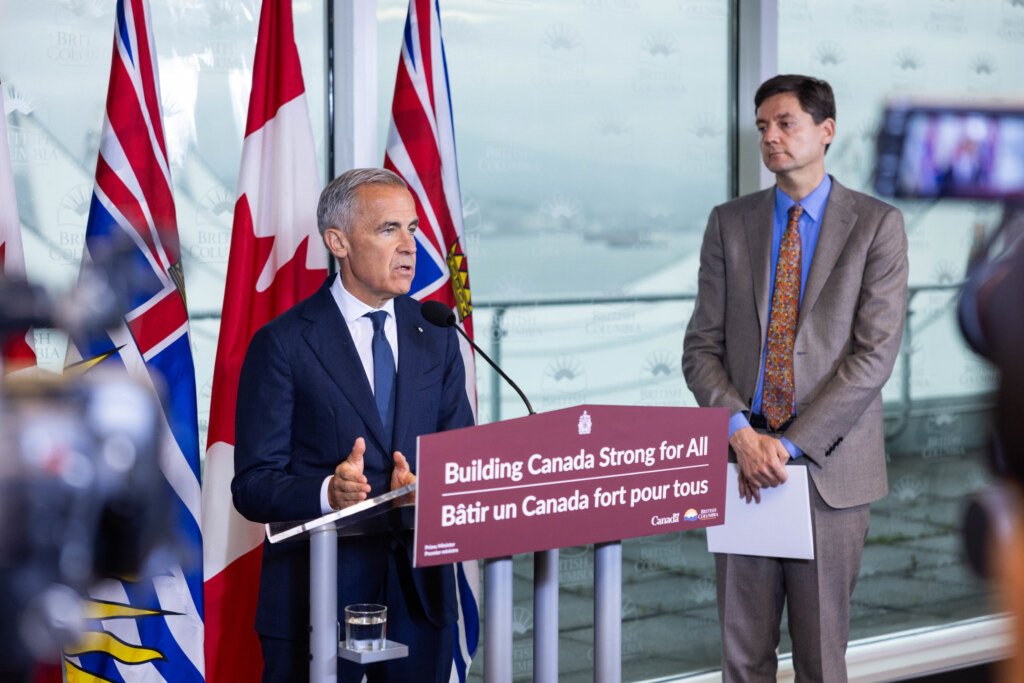
The agreement’s most significant symbolic victory centers on the North Coast tanker ban, which remains fully protected without modification. B.C. also secured compensation provisions should the federal government impose a pipeline on the province—a safeguard that reflects years of tension between provincial environmental stewardship and national resource extraction priorities. The deal explicitly states B.C. need not support any Alberta pipeline proposal, resolving a contentious interprovincial friction point.
Beyond infrastructure, the agreement advances shared commitments to workforce training and child care—critical investments for Metro Vancouver’s labour market. As proposed projects reach final investment decisions over the next three years, B.C. anticipates strengthened public services and fiscal stability. The agreement also signals federal commitment to port infrastructure upgrades and support for forest and steel sectors facing U.S. tariff pressures, positioning B.C. as a reliable trade partner in an uncertain geopolitical environment.

For Surrey and surrounding communities, the deal’s emphasis on workforce training and transportation infrastructure carries direct implications. The Fraser River Tunnel Project will reduce commute times across the Metro Vancouver corridor, while clean energy commitments align with B.C.’s competitive advantage in low-carbon LNG production. Industry analysts note the agreement validates B.C.’s “Look West” economic strategy, which projects $88 billion in major projects reaching investment decisions within three years.
The agreement represents a recalibration of federal-provincial relations under Carney’s government, prioritizing B.C.’s position as Canada’s Pacific gateway. By securing equitable resource-sharing arrangements and environmental protections, the province demonstrates negotiating leverage rooted in its strategic economic importance rather than resource extraction alone

Harnaik Singh Rathor is the Founder, Publisher, and Editor-in-Chief of StudioX News Canada, Canada's multilingual digital news network serving diaspora communities across 44 languages. With a background in media production, public relations, and multicultural communications, he founded StudioX Film and TV Corporation to bridge the gap between mainstream Canadian media and the country's diverse immigrant communities. He is a member of the Canadian Association of Journalists (CAJ), RTDNA Canada, CPRS Vancouver, NEPMCC, and the Canadian Freelance Union (Unifor). Based in Surrey, British Columbia. | LinkedIn: https://www.linkedin.com/in/harnaiksinghrathor/ | Muck Rack: https://muckrack.com/harnaiksinghrathor | Email: editor@studioxnews.ca